
You Hit Publish. Here Is What Google Does Next.
Publishing a blog often feels like the final step. But understanding what happens after you publish a blog changes how you approach SEO entirely.
Most people expect immediate visibility. What actually follows publishing is not visibility. It is a process that Google runs quietly in the background before your page earns a stable position in search results.
In this blog, I will walk through exactly what happens after you publish, why it takes time, and what you can do to help Google move through that process faster.
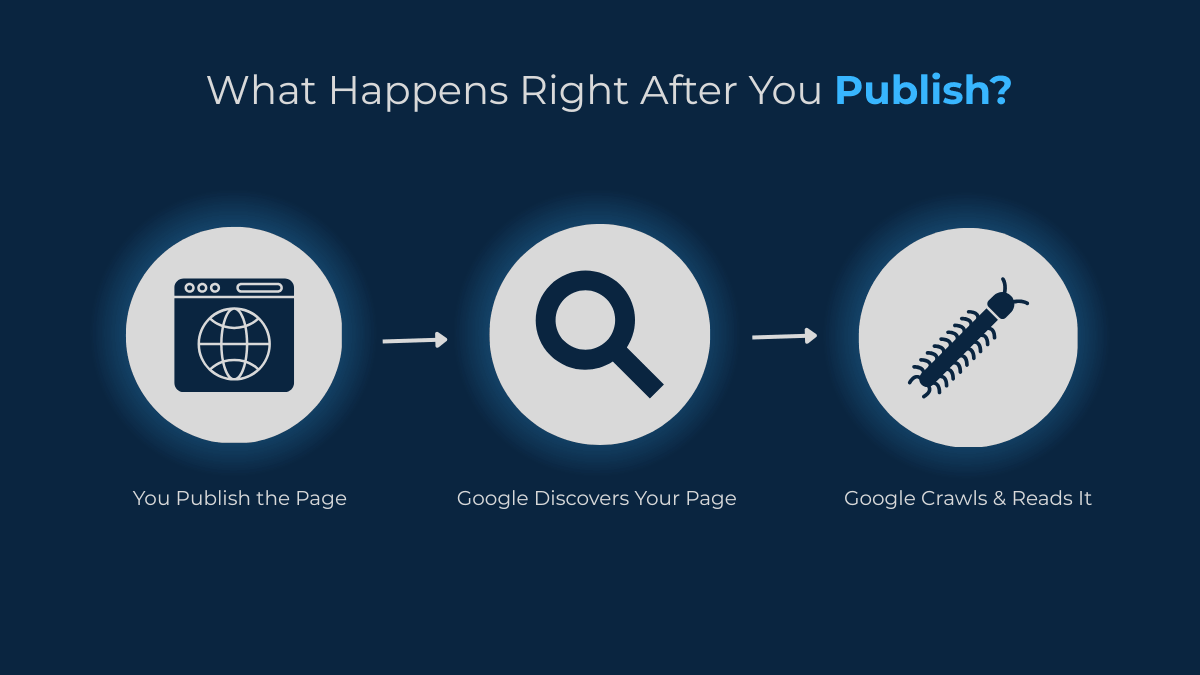
Step 1: What Happens After You Publish, Google Needs to Find Your Page First
The moment your page goes live, it does not automatically appear in Google’s radar. Google needs to discover it first.
Discovery usually happens in one of three ways: through internal links from other pages on your site, through your XML sitemap, or through previous crawl patterns on your domain.
If your website already has a clear structure and active internal linking, discovery tends to happen within a few days. If your site is new or the page has no internal links pointing to it, discovery can take significantly longer.
This is why submitting your URL in Google Search Console immediately after publishing is worth doing. It does not guarantee instant crawling but it signals to Google that the page exists and is ready to be evaluated.
This is also one of the reasons why early SEO can feel inconsistent, which I have explained in detail in why SEO results look random at first.
For a more technical understanding of how Googlebot discovers and crawls pages, you can refer to Google’s official documentation on crawling and indexing.
Step 2: Crawling, Google Reads Your Page
Once Google discovers your page, it sends a crawler to access and read it.
This is the second thing that happens after you publish a blog. Google is not ranking your page at this stage. It is simply understanding it. The crawler looks at your content, headings, structure, internal links, page speed, and how well the page fits within the context of your overall website.
One thing most people overlook here is that Google does not evaluate your page in isolation. It evaluates it in the context of every other page on your site. A well-structured blog surrounded by related content gets understood faster than an isolated page with no connections.
This is exactly why internal linking is not just a nice-to-have. It is how you help Google navigate your site efficiently and build a clearer picture of what your website is about.
Step 3: Indexing, Stored but Not Yet Ranked
After crawling, if Google finds the page worthwhile, it gets indexed. This means it is now stored in Google’s database and is eligible to appear in search results.
But here is where most people get confused. Being indexed does not mean your page will rank. It means it is in the queue. Google still needs to decide where it fits, how relevant it is, and how trustworthy your site is before showing it consistently.
I have explained this specific difference in more detail in indexing vs ranking, because it is one of the most misunderstood parts of how SEO actually works.
Think of indexing as being added to a library. Your book is on the shelf. But whether someone finds it depends entirely on how well it is categorised and how relevant it is to what they are looking for.
Step 4: Testing, The Third Thing That Happens After You Publish a Blog
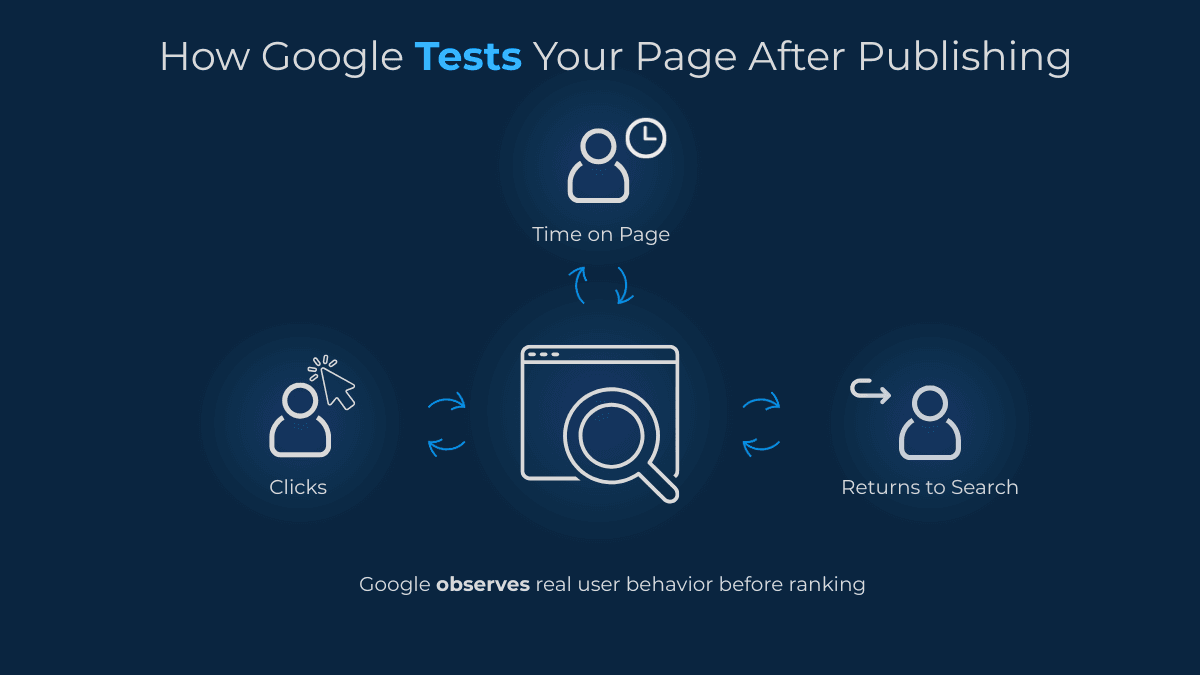
The third important thing that happens after you publish a blog is testing. Google shows your page for specific queries to a small number of users and observes what happens.
This is when you start seeing impressions in Google Search Console, sometimes on different positions, sometimes fluctuating day to day. This is not a problem. It is evaluation.
Google is essentially running a quiet experiment. It watches whether users click your result, how long they stay on your page, and whether they go back to the search results immediately or stick around. This behaviour data tells Google a lot about whether your page genuinely satisfies the query.
Prefer a quick explanation? This short video breaks down how Google tests new pages and why rankings fluctuate in the early phase.
This testing phase is also why SEO feels unstable in the early weeks. Your page is not being penalised. It is being understood.
Step 5: Evaluation of Relevance, Structure, and Topical Fit
After initial testing, Google goes deeper. It evaluates how clearly your content answers the query it was shown for, how it connects with the rest of your site, and whether your website consistently covers the topic area your page belongs to.
This is where many pages slow down or get stuck.
A page about SEO basics on a website that also has pages about cooking recipes and travel tips will confuse Google. There is no clear topical direction. But a page about SEO basics on a website that consistently covers SEO topics, with internal links connecting related content, signals to Google that this website has depth and focus in that subject.
In simple terms, your page is not judged alone. It is judged as part of your website’s overall story.
Step 6: Trust Builds Through Consistency, Not Speed
Even if your page is relevant and well-structured, it still needs to build trust. And trust does not come quickly on a new domain.
Google builds trust through consistent signals over time. These include regular publishing around related topics, stable internal linking, clean site structure, and user behaviour patterns that confirm your content is genuinely useful.
This is the longest phase of what happens after you publish a blog, and it is the one most people do not account for when they expect quick results.
Websites that already have these signals in place tend to rank new pages much faster. New websites have to earn that trust from scratch, which is why the timeline feels slow at first but compounds significantly once the foundation is established.
This is the core reason why some websites rank faster than others, which I have covered in detail in why some websites rank faster than others in SEO.
Why Your Page Feels Stuck After Publishing
If your page has been indexed for weeks but is not progressing, it usually means one of a few things.
Either Google has not gathered enough consistent signals yet to make a confident ranking decision, the page lacks strong internal link support from the rest of your site, or the content does not clearly satisfy the intent behind the queries it is being tested for.
None of these mean your page is rejected. They mean it is still being understood.
The right response is not to keep editing the page repeatedly. Every significant change forces Google to re-evaluate from the beginning. The right response is to strengthen the context around the page, add internal links from relevant existing content, publish supporting blogs that reinforce the same topic, and allow the signals to accumulate.
The Full Journey From Publish to Rank
Here is how I think about it simply.
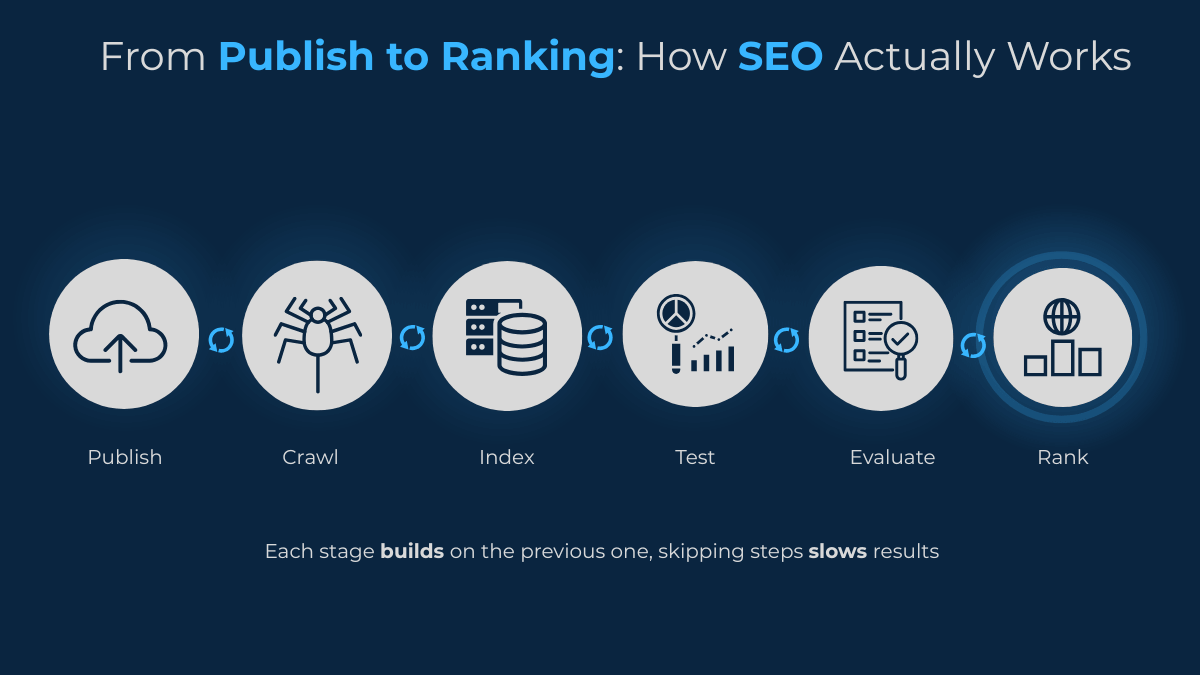
Publishing is introducing your page to Google. Crawling is Google reading it. Indexing is Google storing it. Testing is Google showing it to a small audience. Evaluation is Google deciding how relevant and trustworthy it is. Ranking is Google committing to where it belongs.
Each step depends on the clarity and consistency of everything around it.
What You Should Actually Do After Publishing
Most website owners do not think about what happens after they publish a blog beyond the publishing itself. A better approach is to actively support the page after it goes live.
- Submit the URL in Google Search Console immediately after publishing
- Go back to two or three existing blogs and add a contextual internal link pointing to the new page
- Make sure the new page also links out to at least two related pages on your site
- Keep publishing around the same topic to build supporting context
- Avoid making significant edits to the page for at least four to six weeks unless there is a clear factual error
This is the approach I follow on every page I build on this site. The goal is not to publish and hope. It is to publish and support.
For example, building the SEO services in Haridwar page was not just about writing the page. It involved publishing supporting blogs around it, connecting them through internal links, and giving Google a clear picture of the topical context before expecting the page to gain visibility.
Final Thoughts
Publishing a blog is only the beginning of the process, not the end of it.
Discovery, crawling, indexing, testing, evaluation, and trust-building all happen after you hit publish. Each stage takes time. Each stage depends on how clearly and consistently your website communicates its purpose to Google.
When you understand what happens after you publish a blog, SEO stops feeling like guesswork. It becomes a series of deliberate decisions that build on each other over time.
Consistency does not just help rankings. It is what makes rankings possible in the first place.