
Your Page Is Indexed but Not Ranking. Here Is What Google Is Still Waiting For.
when your page is indexed but not ranking yet, it feels confusing despite feeling like a milestone And it is.
But for most new websites, indexing is immediately followed by a frustrating silence. Impressions stay low, rankings do not appear, and the page feels invisible despite being in Google’s system.
This is one of the most common points of confusion in SEO, and it usually comes down to one misunderstanding: indexing and ranking are not the same thing, and they do not happen at the same time.
In this blog, I will walk through exactly what Google is evaluating after your page gets indexed, why it takes time, and what actually moves a page forward.
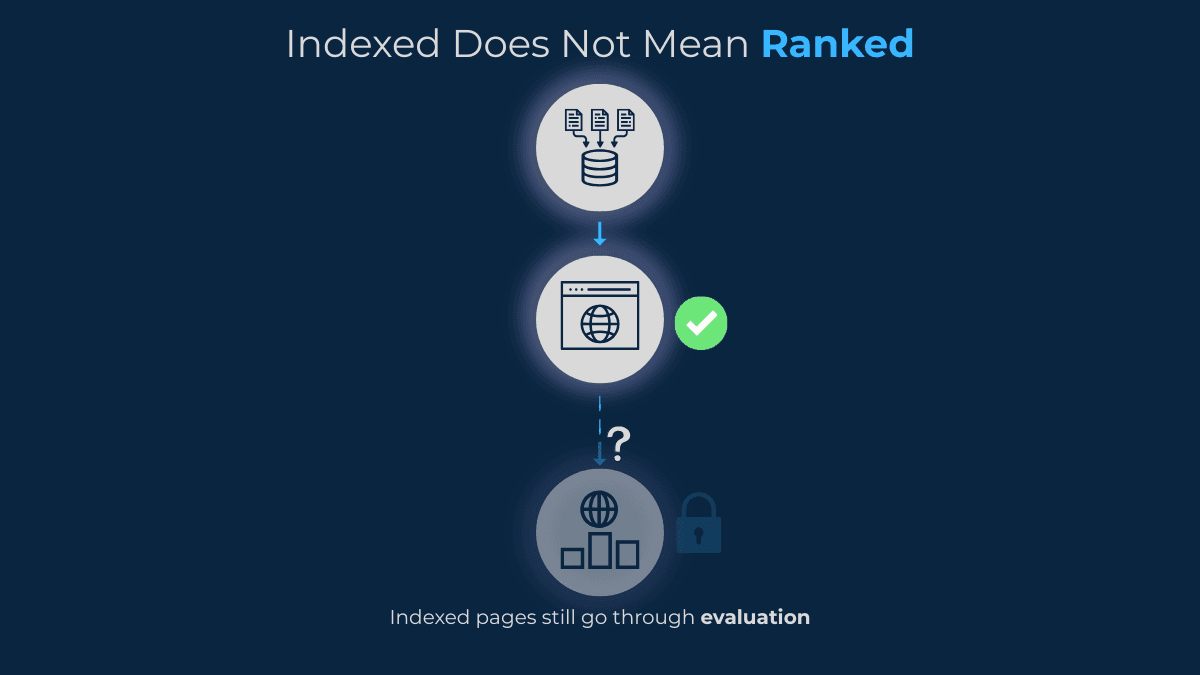
Indexing Is Entry, Not Approval
When Google indexes your page, it is storing it in its database and marking it as eligible to appear in search results.
That word, eligible, is important. It means your page can appear. It does not mean it will.
Google indexes millions of pages every day. Only a fraction of them get consistent visibility. Indexing is the entry point into the system. Ranking is what happens after Google evaluates whether your page deserves to be shown for specific queries.
If you want a clearer breakdown of this specific distinction, I have explained it in detail in indexing vs ranking.
In simple terms, indexing gives your page a place in the system. Ranking gives it a reason to be chosen.
What Google Is Actually Doing After Indexing
After your page is indexed, Google does not immediately decide where to rank it. It begins a process of observation and testing that most people never see.
First, Google evaluates how clearly your page answers a specific query. It looks at your content structure, headings, depth of explanation, and whether the page satisfies what someone searching that query actually wants to know. A page that answers one question clearly will always outperform a page that attempts to cover many things without depth.
Second, Google looks at how your page connects to the rest of your website. A page on a website with related content, strong internal links, and consistent topical focus is much easier to evaluate than an isolated page with no connections. Google uses those connections to understand what your page is about and how authoritative your site is on that subject.
Third, Google may begin testing your page by showing it to a small number of users for specific queries. It observes what happens. Do users click? Do they stay on the page or go back to search immediately? This behaviour data tells Google whether your page genuinely satisfies the query or just appears relevant on the surface.
This entire process is also what I described in what happens after you publish a blog, where I walked through each stage from publishing to ranking in more detail.
Why Relevance Alone Is Not Enough to Rank
This is where a lot of good pages get stuck and their owners cannot figure out why.
For almost every query on Google, there are multiple pages that are relevant. Google does not show all of them. It picks the ones it is most confident about.
When your page is new, Google has very little data to go on. It has read your content, but it has not yet seen how users respond to it. It has checked your structure, but it does not yet know how your website will develop over time. In this situation, Google defaults to caution. It may show your page occasionally to gather data, but it will not commit to a stable ranking until it has enough confidence.
This is not a penalty. It is not a problem with your page. It is Google being careful about what it shows to users.
The question you should be asking is not why is my page not ranking yet. It is what signals am I building that will make Google more confident about this page over time.
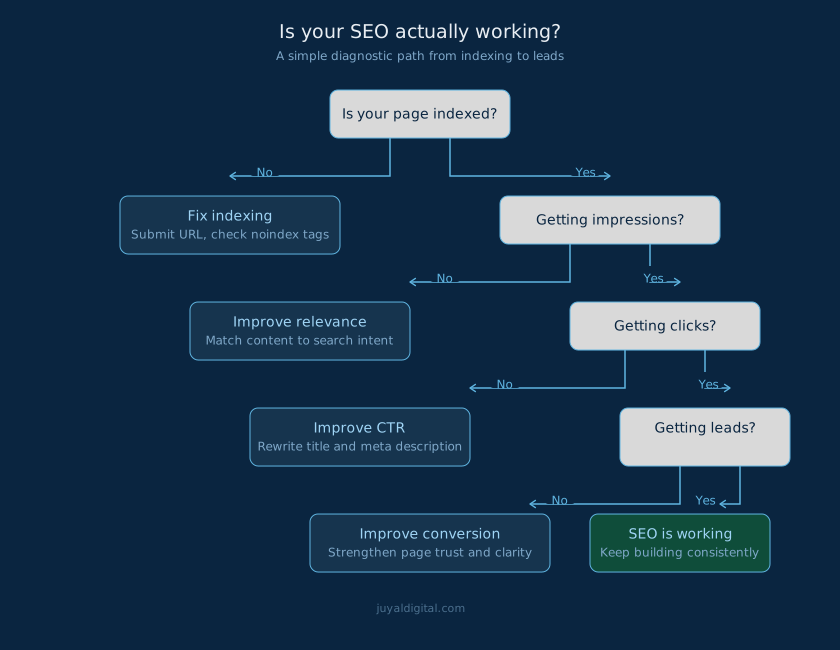
Use this framework to identify where your page is currently getting stuck before making unnecessary SEO changes.
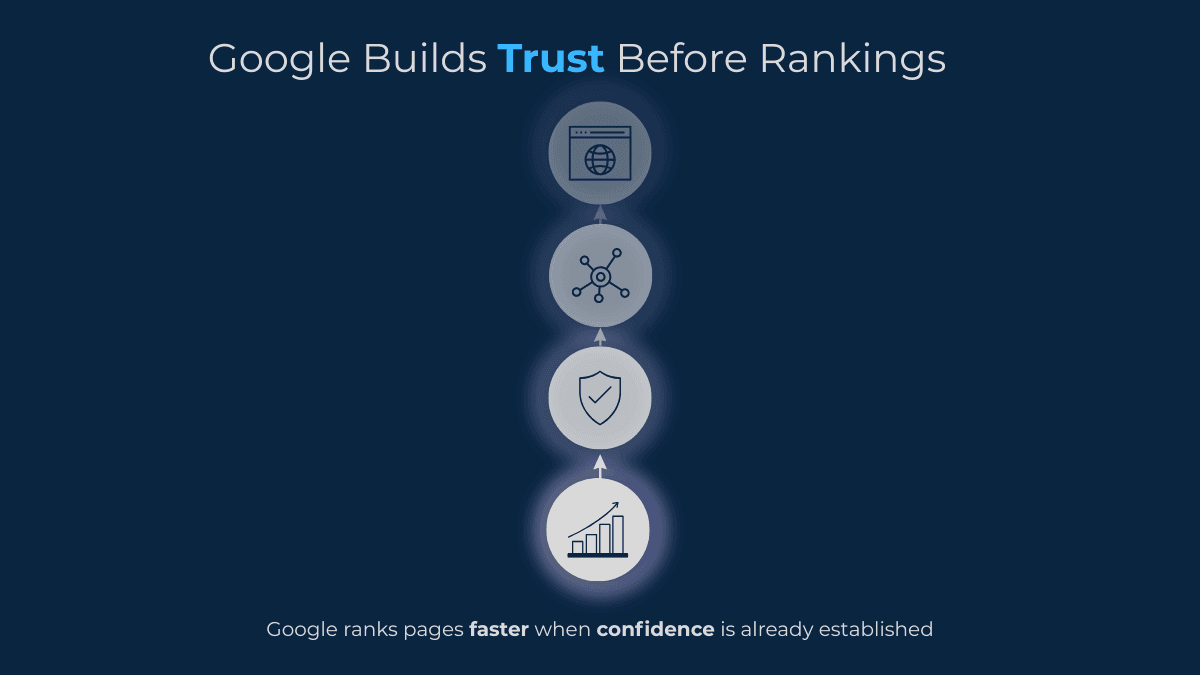
Why New Websites Face This More Than Established Ones
If you have ever wondered why an older website can publish a page and rank within days while your new site waits weeks for the same result, this is the answer.
Established websites have built up a track record. Google has years of crawl data, user behaviour signals, and content patterns to draw from. When a trusted site publishes something new, Google can make a confident ranking decision much faster because it already knows how that site’s content performs.
New websites have none of that history. Every page is essentially Google’s first real impression of the site. So it moves cautiously, collects data slowly, and builds confidence over time rather than immediately.
This is not something you can rush. But it is something you can accelerate by building the right signals consistently, which is exactly what the next section covers.
What Actually Moves a Page Forward After Indexing
There is no single action that takes a page from indexed to ranking. It is a combination of signals that reduce Google’s uncertainty about your page and your website overall.
The most impactful things you can do are:
- Build internal links from existing indexed pages to the stuck page. Every internal link from a page Google already trusts passes a small amount of credibility to the page it points to. If your indexed page has no internal links pointing to it from elsewhere on your site, it is essentially invisible to Googlebot’s natural crawl patterns.
- Publish supporting content around the same topic. A single page on a topic gives Google one data point. Three or four connected pages on related aspects of the same topic signal topical depth, and topical depth builds trust faster than isolated content.
- Improve the depth and clarity of the page itself. If your page answers a question but stops short of fully explaining the mechanism, the context, or the practical next step, it is less likely to satisfy the query than a competitor who goes deeper. Depth signals effort and expertise.
- Keep the page stable. Frequent edits, especially major rewrites, reset Google’s evaluation process. Once you have published and internally linked a page, give it at least four to six weeks of stability before making significant changes.
Why This Matters Even More for Service Pages
Everything above applies to blog posts, but it matters even more for service pages.
A service page is typically competing against established local businesses with years of history. It also needs to satisfy a higher-intent query, someone who is not just looking for information but is considering making a decision.
For a service page to rank, it needs strong topical support from surrounding content, clear internal links from blogs that cover related questions, and enough trust signals on the domain that Google feels confident showing it to someone with buying intent.
This is the approach I am following with my own SEO services in Dehradun page. The page exists and is structured correctly, but ranking it requires building the content and internal linking ecosystem around it before expecting consistent visibility.
The Mistake Most People Make at This Stage
When a page is indexed but not ranking, the most common reaction is to start changing things. Rewrite the content, target different keywords, add more sections, remove sections, change the title repeatedly.
This is understandable but counterproductive. Every significant change to a page resets Google’s evaluation of it. Instead of building on the data Google has already collected, you are asking it to start over.
The pages that eventually rank well are almost always the ones that were published, properly supported, and then left stable while the surrounding signals were built up consistently.
In simple terms, patience is not just advice. It is part of how the ranking process actually works.
Final Thoughts
If your page is indexed but not ranking, it does not mean something is broken. It means Google has not yet gathered enough confidence to commit to a stable position for your page.
The right response is not to react. It is to build. More supporting content, stronger internal links, deeper topical coverage, and consistent structure all give Google the signals it needs to move your page forward.
Indexing is the beginning of evaluation. Ranking is the result of confidence. And confidence is built through consistency, not speed.