
Why Copying Competitor Keywords Is the Slowest Way to Rank (And What to Do Instead)
Copying competitor keywords is one of the most widely taught tactics in SEO. Open a tool, analyse what your competitors rank for, target the same keywords, publish similar content, and wait for rankings to follow. It feels logical, data-backed, and safe.
But in practice, copying competitor keywords is often one of the slowest ways to build SEO momentum, especially for newer or smaller websites. And understanding why helps you avoid wasting months of effort on a strategy that was never going to work the way you expected.
In this blog, I will explain why this approach creates slow or no results, how Google actually evaluates pages beyond keyword matching, and what I have found works far better for building long-term organic authority on a new website.
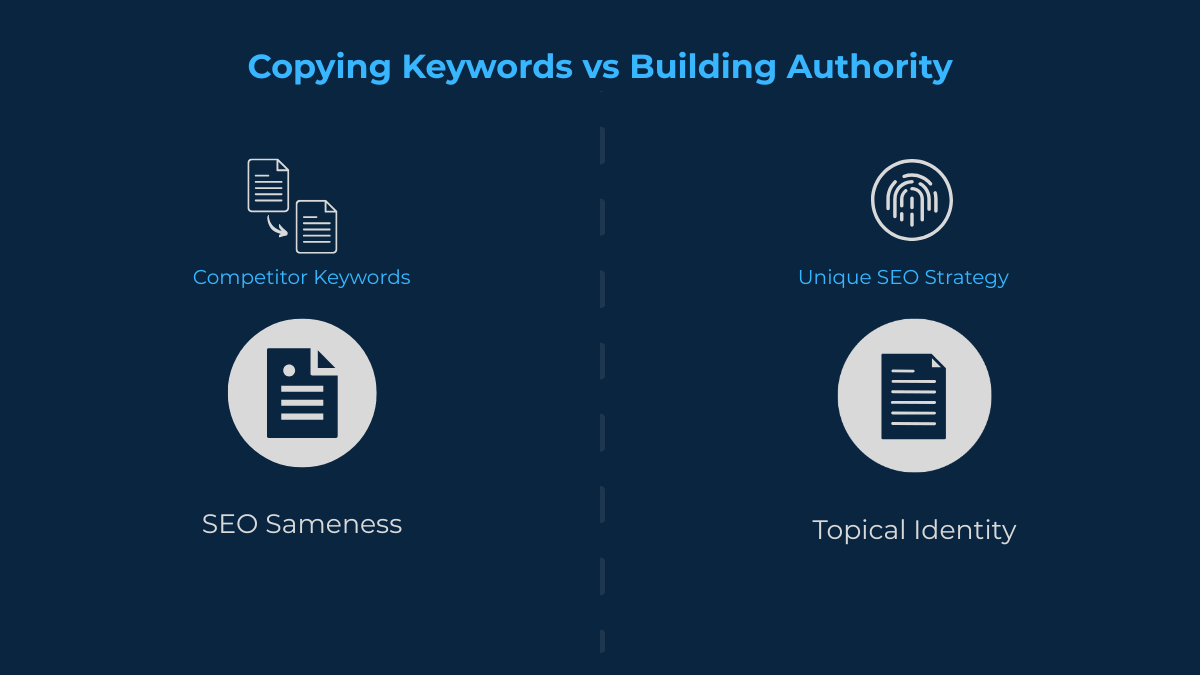
Why Copying Competitor Keywords Became So Common in SEO
The rise of keyword research tools made SEO feel predictable in a way it never really was. Instead of understanding search behaviour deeply, the process became: find what competitors rank for, create similar pages, and expect similar results.
This created a dangerous illusion. It made many businesses believe rankings come from keyword duplication rather than from building genuine topical authority and contextual relevance.
What the Tools Show You and What They Miss
Competitor keyword tools show you the output of a competitor’s SEO strategy. They show you which keywords that site currently ranks for. What they cannot show you is the years of crawl data, user behaviour signals, topical consistency, and internal content structure that made those rankings possible.
When you copy the keywords without understanding the ecosystem behind them, you are targeting the symptom of your competitor’s success rather than the cause of it. The result is content that competes in the same space but carries none of the signals that made the original content rank.
According to Backlinko’s SEO best practices guide, modern Google evaluates topical depth, content usefulness, and contextual relevance at a site-wide level rather than simply matching keywords on individual pages. Copying keywords without building the topical depth behind them is one of the most common reasons well-written pages still fail to rank.
Why Google Already Trusts Your Competitor More Than It Trusts You
This is the core of why copying competitor keywords produces such slow results, and it is the part most SEO content skips over.
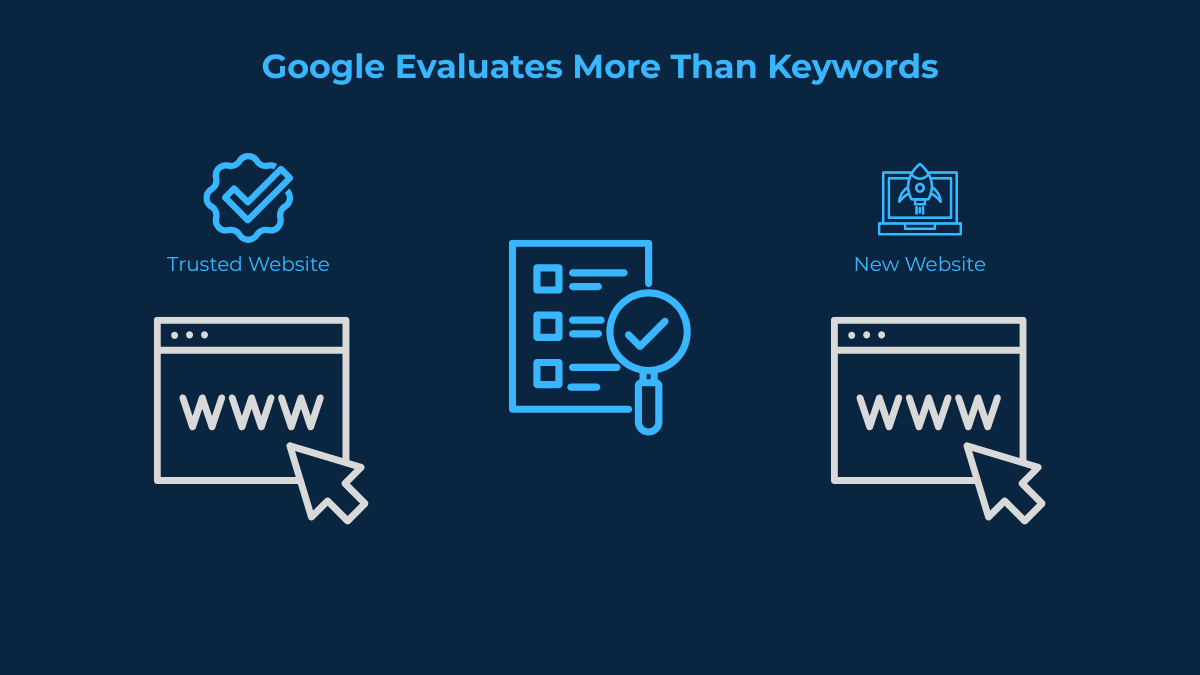
When a website already ranks strongly for competitive topics, Google has spent significant time evaluating that website. It has observed how users interact with that content across hundreds or thousands of queries over months or years. It has mapped the topical relationships between that site’s pages. It has built a model of what that website is about and how reliably it delivers useful answers.
What Google Sees When a New Website Copies Those Keywords
When a newer website enters that same search space by publishing similar content around identical keywords, Google compares both sites. The newer site may have well-written content. But it has none of the accumulated signals the established competitor carries. No engagement history. No behavioural patterns. No demonstrated topical consistency over time.
From Google’s perspective, there is no compelling reason to move the newer site above the established one. The burden of proof is entirely on the newcomer, and keyword similarity alone does not meet that burden.
This is closely connected to what I explained in my blog on why your page is indexed but not ranking. Indexing content does not mean Google trusts it enough to replace existing search leaders. Trust is built through accumulated signals over time, not through keyword targeting alone.
I observed this directly while building Juyal Digital. In the early months, I deliberately avoided targeting keywords that established SEO websites already owned. Instead, I focused on questions and angles that those sites covered only briefly or not at all. That approach gave Google a reason to evaluate my content on its own terms rather than comparing it unfavourably against already-trusted competitors.
How Copying Competitor Keywords Creates SEO Sameness
When many websites in the same niche copy each other’s keyword strategies, they converge on the same topics, the same angles, and the same content structures. The result is a search landscape filled with pages that are nearly identical in topic and approach but differ only in writing quality and domain authority.
Google does not reward sameness. It rewards pages that most precisely satisfy the search intent behind a query. When multiple pages are equally similar in topic and approach, the ranking decision defaults to whichever site Google already trusts most. For a newer or smaller website, that almost always means losing.
Why Differentiation Matters More Than Optimisation
The websites that break through in competitive niches almost always do so by bringing something different to the conversation, not by optimising a copy of what already exists. A different angle on a familiar topic, a more specific audience focus, a more honest explanation of a common misunderstanding, or a perspective grounded in real personal experience rather than generic advice.
This is one reason why many businesses feel SEO takes forever. Not because SEO itself is slow, but because the strategy lacks originality. The website enters a saturated space without creating a unique topical identity, and Google has no compelling signal to prefer it over what is already there.
Why You Are Copying Keywords but Not the Ecosystem Behind Them
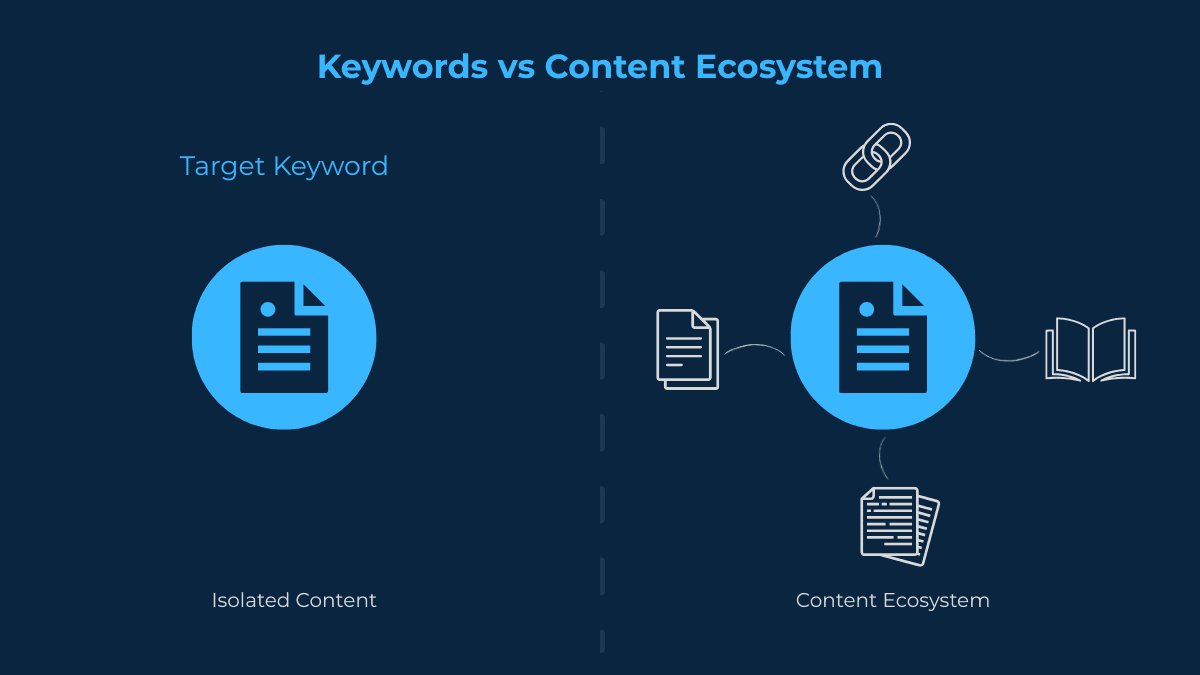
One of the most important things people miss when copying competitor keywords is that the keyword is only visible evidence of a much deeper structure. High-ranking pages almost always sit inside a content ecosystem, supported by dozens of related pages, internal links, and accumulated topical signals that the keyword tool never shows you.
A competitor ranking for “SEO services for small businesses” likely has supporting blogs about why small businesses need SEO, what SEO results look like for small businesses, how long SEO takes for small businesses, and what mistakes small businesses make with SEO. Those supporting pages feed authority and topical relevance to the main ranking page constantly.
What Happens When You Target the Keyword Without the Ecosystem
When you create one page targeting that same keyword without any of the surrounding ecosystem, your page competes against not just the competitor’s ranking page but against the entire topical structure supporting it. One page versus a full content cluster is not a fair competition.
This is exactly why I explained in my blog on internal linking SEO that Google increasingly evaluates relationships between pages, not isolated keyword targets alone. A single page with the right keyword will almost always lose to a network of connected pages that collectively demonstrate deep topical understanding.
Building the ecosystem first, even before targeting competitive keywords, is what eventually makes those keyword targets achievable.
Why Search Intent Alignment Beats Copying Competitor Keywords
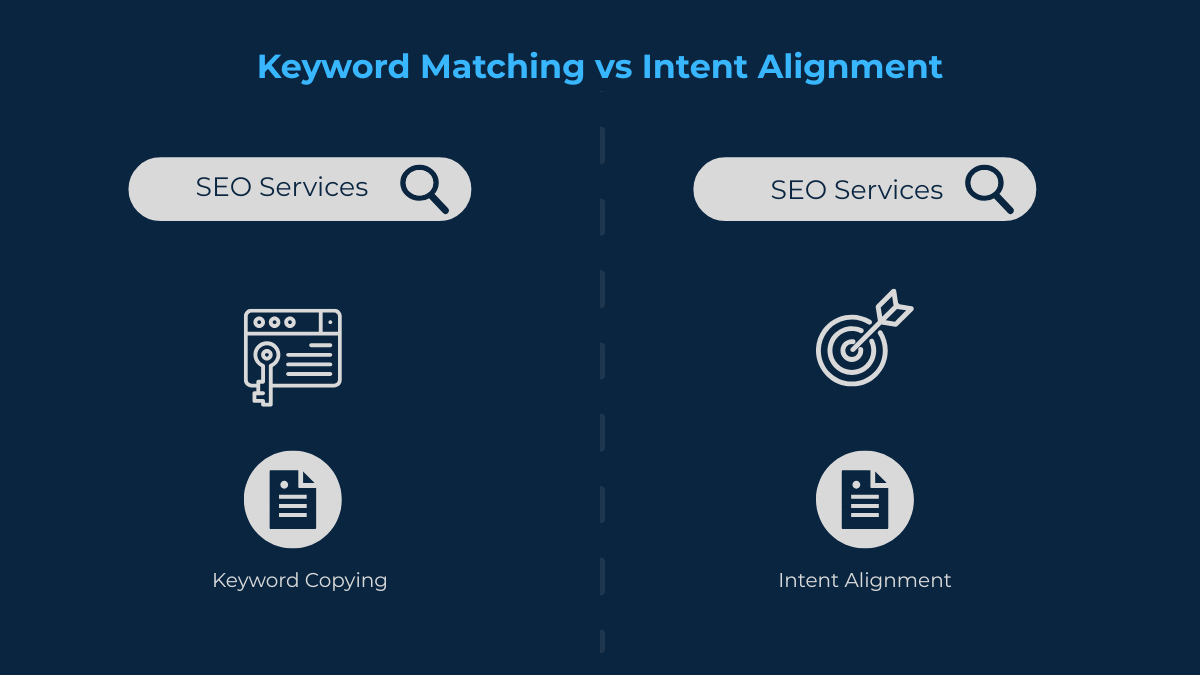
Many businesses focus so heavily on keyword matching that they miss search intent entirely. But understanding what a searcher actually wants when they type a query, not just what words they used, is what determines whether your page satisfies them.
Two pages targeting identical keywords can perform very differently because one genuinely solves the user’s problem and the other only mentions the relevant keywords. Google measures this through behavioural signals: do users click, stay, explore, and come back? Or do they click and immediately return to the search results?
How Intent Mismatch Quietly Kills Rankings
When a page is built by copying competitor keywords without understanding the intent behind those keywords, it often creates intent mismatch. The page appears relevant based on keyword presence but fails to satisfy what the searcher actually needed. Google observes this through engagement signals and gradually deprioritises the page regardless of how well it was optimised on the surface.
This is also deeply connected to what I explained in my blog on why your website is getting traffic but no leads. Traffic quality depends heavily on intent alignment. A page that attracts clicks through keyword matching but fails to deliver what the searcher wanted will generate impressions and even clicks without generating any meaningful business outcome.
For a local business, this matters especially. Someone searching for “SEO services in Haridwar” has a very different intent from someone searching “what is SEO.” The first person is ready to evaluate and potentially hire. Copying keywords from an educational SEO website and directing local commercial searches to that content creates a mismatch that serves neither the searcher nor the business.
This is why my SEO services in Haridwar page and my SEO services in Dehradun page are built around the specific intent of a local business owner evaluating an SEO consultant, not around the keywords an educational SEO blog would target. The intent is different, the content needs to be different, and copying competitor keywords from the wrong category would have produced the wrong audience entirely.
How to Use Competitor Research Without Copying Competitor Keywords
Competitor keyword research is not useless. Used correctly, it is genuinely valuable. The problem is not researching competitors. The problem is using that research to copy rather than to understand.
Here is how I use competitor research more effectively:
Look for What Competitors Are Not Covering Well
The most valuable insight from competitor research is not which keywords they rank for. It is which questions their content answers poorly or not at all. Every competitive website has gaps, topics it covers only briefly, questions it dismisses with generic answers, or perspectives it never considers because it targets a broad audience.
Those gaps are where a newer website can build genuine authority faster. A page that covers an under-served topic thoroughly will rank more quickly than a page competing directly against established content on an over-served topic.
Use Competitors to Understand Topic Structure, Not Keyword Lists
Looking at how a competitor organises their content across multiple pages tells you far more than their keyword list does. Which topics do they cover in depth? Which ones do they mention in passing? How do their blogs and service pages connect? That structural understanding helps you build a more coherent content ecosystem rather than just a collection of keyword-targeted pages.
On Juyal Digital, I looked at what the broader SEO content space was saying about new website growth, indexing, and ranking, and then focused specifically on the angles that felt most honest and most useful for someone actually building a site from scratch. That positioning created contextual distinction. And contextual distinction is what gives Google a genuine reason to rank your content alongside or above established competitors over time.
What Actually Works Better Than Copying Competitor Keywords
Based on everything I have observed building Juyal Digital from zero and studying how Google evaluates content, here is what consistently produces better results than competitor keyword copying:
Build a topical cluster around your genuine area of depth. Choose a specific topic area where you can publish five to ten connected pieces of content that collectively demonstrate deeper understanding than any single competitor page. This builds topical authority faster than scattered keyword targeting ever will.
Target long-tail, specific queries before broad competitive ones. Long-tail queries have lower competition because most websites ignore them in favour of higher-volume terms. But the visitors they attract have higher intent, more specific needs, and a greater likelihood of becoming actual clients or customers. Building from long-tail wins creates the momentum that makes broader competitive terms achievable later.
Write from experience, not from research alone. Content written from genuine experience, real observations, and first-hand knowledge creates differentiation that no keyword tool can replicate. Every section of this blog on Juyal Digital reflects something I have actually observed or experienced. That specificity is what makes content feel authoritative rather than generic.
Connect every piece of content to the others deliberately. A blog that sits in isolation contributes far less than a blog that connects to four related pages through internal links. Building the internal structure of your website is the part most keyword-copying strategies completely miss, and it is often the difference between content that ranks and content that does not.
If you want to understand what a structured, intent-driven SEO approach looks like in practice, you can explore my SEO consulting services page, where I explain exactly how I apply these principles for local businesses, or read my SEO case study to see how this approach produced real results on a new domain from launch.
Final Thoughts
Copying competitor keywords is not worthless. But as the primary SEO strategy for a newer or smaller website, it is almost always the slowest possible path to meaningful rankings.
Google has already spent years building confidence in your established competitors. Entering their keyword space with a similar page and expecting similar results ignores the entire trust and authority gap between you. The gap is real, and keyword targeting alone does not close it.
What does close it is building your own topical identity, covering topics with genuine depth and original perspective, aligning content with the specific intent of your actual audience, and creating the internal content structure that gives Google a clear, coherent picture of what your website is about.
In modern SEO, differentiation matters more than duplication. The websites that grow consistently are the ones that give Google a reason to prefer them, not just another page saying the same things slightly differently.
If you want to go deeper on how Google evaluates new content and why rankings take the time they do, my blog on why SEO results look random at first explains the full evaluation and testing process that determines where your pages eventually settle.