
Why Your Homepage Is Probably Your Weakest SEO Page (And What Actually Ranks Instead)
Most businesses do not understand homepage SEO and invest the most time, design effort, and expectation into their homepage. And from a branding perspective, that makes complete sense. The homepage represents the business, creates first impressions, and welcomes every visitor.
But homepage SEO rarely works the way most business owners expect. In practice, I have seen many websites where the homepage becomes one of the weakest pages for organic search performance, not because it is poorly designed, but because it is trying to do too many things at once for search engines to understand clearly.
Google does not rank pages based on their importance to the business. It ranks pages based on how precisely they match the specific intent behind a search query. And homepages, by their nature, are built to serve everyone rather than answer one specific question well.
In this blog, I will explain why homepage SEO often underperforms, what actually drives organic growth in modern SEO, and how to think about your homepage’s real role in the structure of your website.
Why Businesses Overestimate Homepage SEO Performance
One of the most common misconceptions I come across is this: if the homepage ranks well, the entire website will succeed in search. It feels logical because the homepage is the main page, the face of the business, and the page most people think of first.
But modern homepage SEO does not work that way. Google does not automatically treat the homepage as the best answer for every search related to your business. Instead, it tries to match search intent as precisely as possible, and that matching happens at the page level, not the website level.
How Search Intent Changes Which Page Ranks
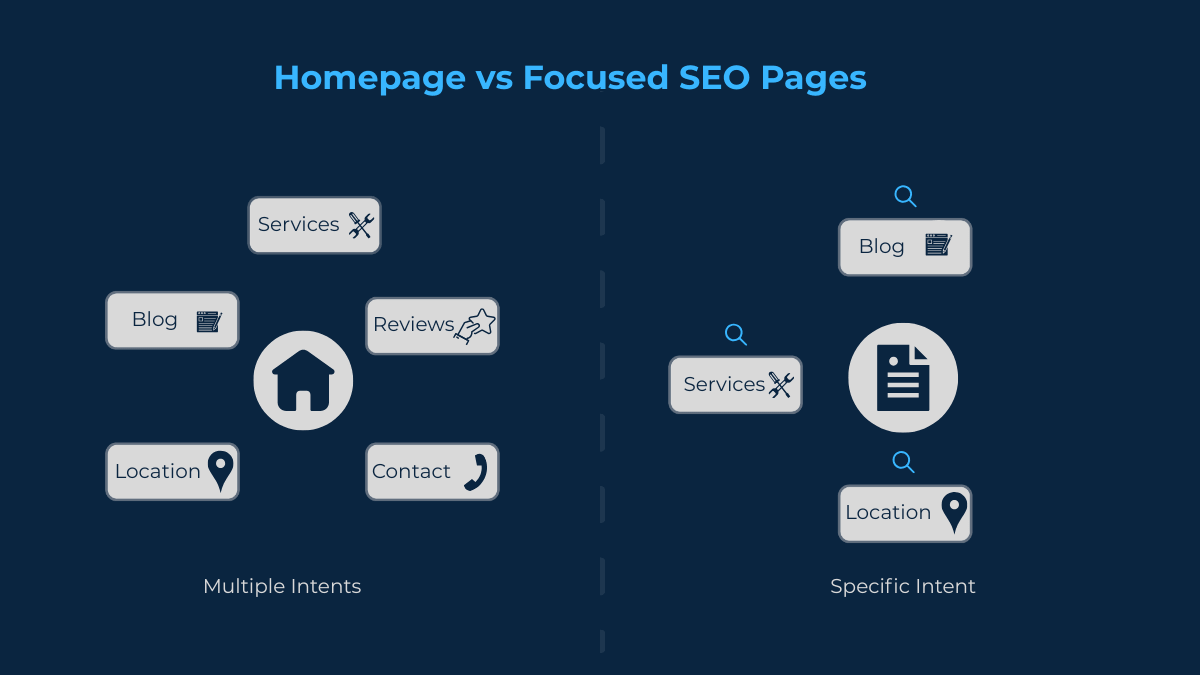
This means educational searches usually match blogs. Service-based searches match service pages. Local searches match location pages. Specific problems match focused content. And the homepage, which tries to address all of these simultaneously, often ends up being the best match for none of them.
For example, someone searching “what happens after publishing a blog” or “why is my page indexed but not ranking” is not looking for a homepage. Google will almost always prefer a page that directly and specifically answers that question. This is exactly why I built focused blogs like what happens after you publish a blog and why your page is indexed but not ranking rather than trying to address these questions through the homepage.
As Backlinko’s on-page SEO guide explains, optimising for search intent means creating specific pages that match exactly what a user is looking for at each stage of their search journey. A homepage optimised for broad brand messaging cannot simultaneously optimise for the specific intent behind dozens of different queries.
Why Homepages Become Too Broad for Homepage SEO to Work Well
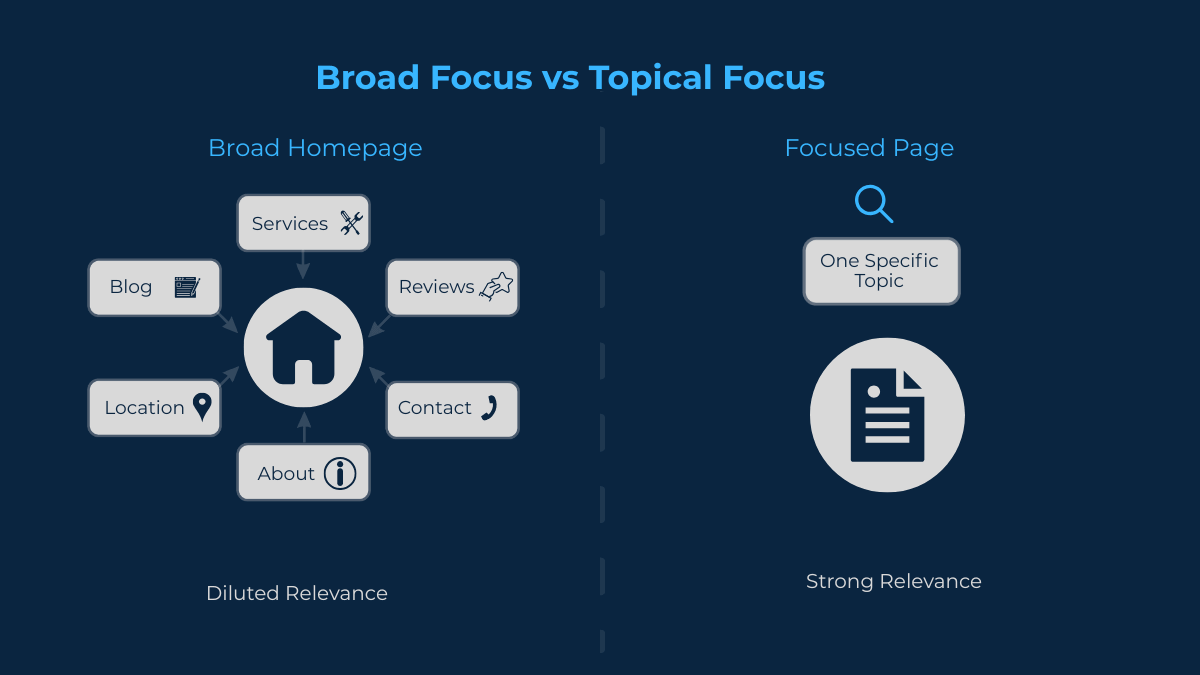
Most homepages try to serve everyone, and that becomes a significant SEO weakness. A typical homepage includes multiple services, brand messaging, company introduction, testimonials, calls to action, navigation pathways, and a mixture of industry keywords all on a single page.
The result is a page with diluted topical focus. And when topical focus weakens, search intent alignment weakens with it. Google cannot confidently rank a page that is simultaneously trying to be relevant to ten different queries. It will rank the page for none of them consistently rather than the best of all of them.
What Focused Pages Do That Homepages Cannot
A dedicated page discussing one clear topic creates far stronger contextual relevance than a homepage attempting to cover everything. On Juyal Digital, for example, the page about internal linking SEO ranks for internal linking queries, the page about why SEO results look random ranks for that specific question, and my SEO services in Haridwar page ranks for local service searches. None of these would rank through the homepage because the homepage simply cannot carry all of that specificity at once.
This is not a weakness of the homepage as a page. It is a structural reality of how Google evaluates relevance. A page that answers one question thoroughly will almost always outperform a page that mentions ten things briefly.
Google Prefers Contextual Relevance Over General Website Importance
A lot of businesses still assume Google ranks pages based on brand authority or website importance. The homepage is the most important page internally, so it should rank most prominently externally. But Google’s systems evaluate relevance and intent match at the page level, not the website level.
Search engines analyse contextual depth, content specificity, search intent alignment, topical relationships, and user satisfaction patterns. A deeply focused page can and regularly does outperform a homepage from the same website for queries that fall within its specific topic.
A Real Example of This in Practice
If someone searches “SEO consultant in Dehradun,” Google will almost always prefer a dedicated local page like my SEO services in Dehradun page over the homepage, because the local page creates clearer intent alignment, stronger topical signals, and more relevant contextual information for that specific query.
Similarly, if someone searches for “why does SEO take so long,” a focused educational blog will rank above a homepage every time, because the blog was written to answer that exact question and the homepage was not.
This shift toward contextual relevance is one of the most important things to understand about modern SEO. Ranking strength increasingly comes from relevance precision, not page seniority.
Why Blogs and Service Pages Drive More Homepage SEO Growth Than the Homepage Itself
In many well-structured websites, blogs and service pages quietly become the real organic growth engines while the homepage remains relatively static in search performance.
The reason is straightforward. These pages target specific questions, clear intent, focused keywords, problem-driven searches, and transactional relevance. Each one adds a new entry point for a different type of search that the homepage could never cover on its own.
How This Works as a Content Ecosystem
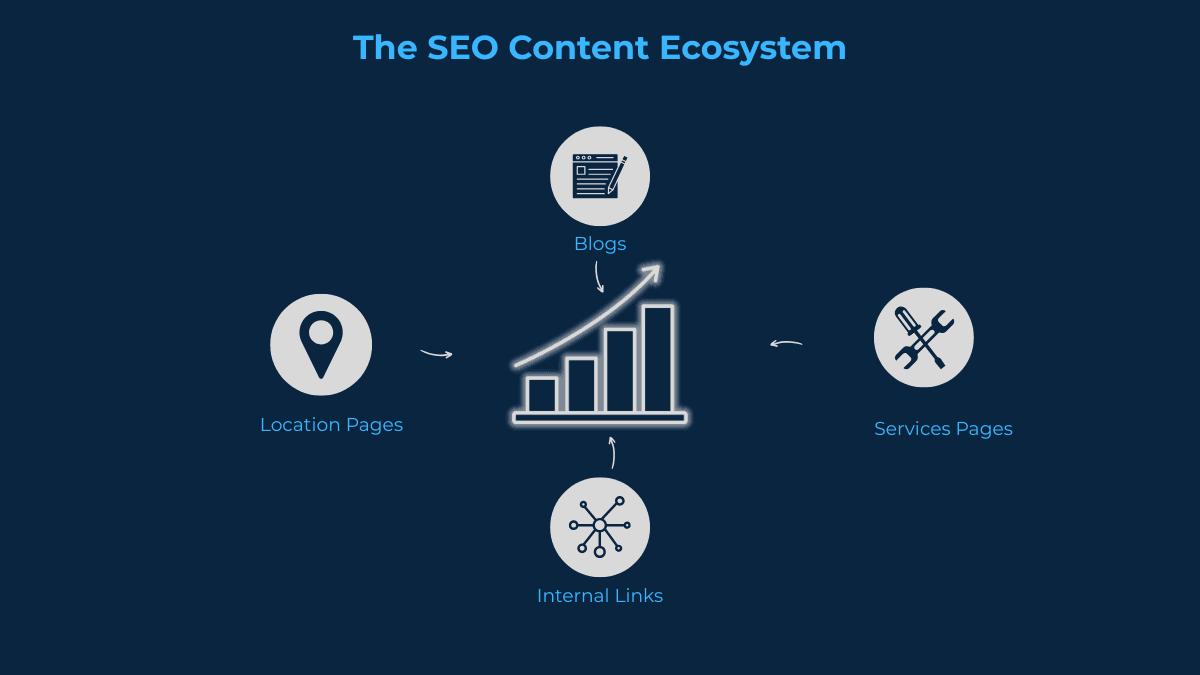
Modern SEO works more like a content ecosystem than a homepage-centric model. Every focused page adds another layer of topical understanding to the website. Blogs build informational authority. Service pages build transactional relevance. Location pages strengthen local intent. Internal links connect everything structurally. Together, this creates a much stronger SEO system than any single page could support alone.
This is exactly why I built a dedicated SEO services page for Juyal Digital, separate from the homepage, rather than expecting the homepage to explain every service offering in depth. The services page can go into the detail that clients actually need when they are evaluating whether to hire an SEO consultant. It can address specific questions, explain the process, and build confidence in a way that a homepage introduction simply cannot replicate.
A homepage that tries to be the services page, the blog, and the about page simultaneously ends up being none of them effectively. Separating these functions allows each page to do its specific job well.
How Internal Linking Changes the Real Role of the Homepage in SEO
None of this means the homepage becomes unimportant. It means its role changes significantly from what most business owners assume it to be.
Instead of being the page that ranks for everything, the homepage becomes a trust hub, a navigation gateway, an authority distributor, and a structural entry point for visitors who already know the brand. It is the page that welcomes people who arrive from direct traffic, branded searches, or referrals. And it is the page that distributes authority across the website through internal links.
Why Homepage Authority Still Matters for the Whole Website
The homepage typically accumulates the most external authority on any website because it is the page most commonly linked to from external sources. That authority does not disappear. But it becomes most valuable when it flows outward through strong internal links to the focused pages that are doing the actual ranking work.
As I explained in my blog about internal linking SEO, modern websites grow stronger when authority flows strategically between connected pages. The homepage helps initiate that flow. The service pages, blog posts, and location pages provide the topical depth that earns the actual rankings.
This creates a healthier SEO architecture overall. Instead of relying on one broad page, the website develops multiple strong intent-driven entry points, each one reinforced by the authority flowing from the homepage through internal links.
Why Homepages Often Fail to Convert Homepage SEO Traffic Properly
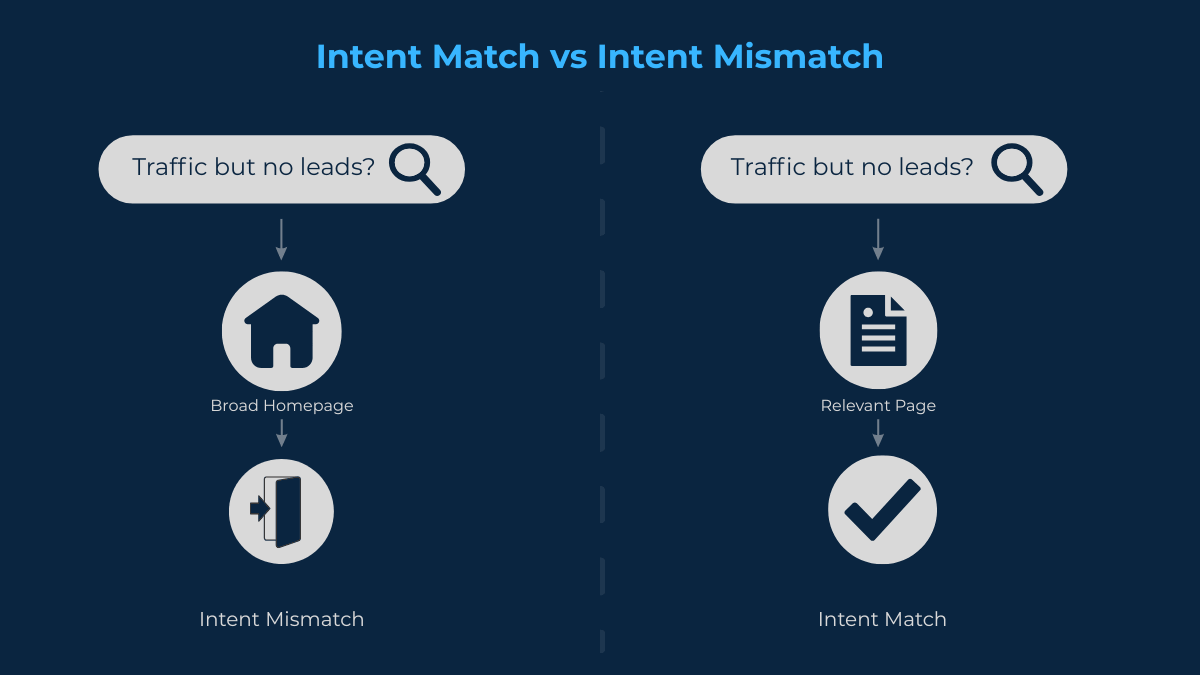
There is another dimension to this problem that goes beyond rankings. Even when a homepage does attract organic traffic, it often fails to convert that traffic effectively because the visitor’s intent does not match what the homepage delivers.
A user searching “why my website gets traffic but no leads” expects educational clarity and a specific answer. If that visitor lands on a general homepage that talks about the business rather than addressing their question, they will leave quickly. The search intent mismatch is immediately obvious to the user even if they cannot articulate why.
How the Visitor Journey Actually Works
Visitors build trust gradually through multiple interactions, not in a single visit. They move through stages: discovering the brand, reading educational content, comparing alternatives, revisiting to confirm their evaluation, and eventually making contact. Focused pages support each of these stages far better than a homepage trying to shortcut the entire journey into a single page.
A blog post about a specific problem builds the first layer of trust. A service page that addresses their specific situation builds the second. And a clear path between those pages, created through internal linking, guides the visitor naturally toward contact rather than leaving them to figure out the next step on their own.
This connects directly with what I explained in my blog on why your website is getting traffic but no leads, where I cover the full gap between visibility and conversion and why intent alignment at the page level is what actually closes that gap.
For local businesses in Haridwar specifically, this journey matters enormously because potential clients searching for local SEO help are often evaluating multiple options. A focused page that speaks directly to their situation, like my SEO services in Haridwar page, will always perform better than a generic homepage in both rankings and conversion for that specific intent.
What the Homepage Should Actually Be Optimised For in Modern SEO
Given everything above, the question becomes: what should you actually optimise your homepage for?
The most effective approach is to optimise your homepage for your brand name and your broadest service category, nothing more. If you are an SEO consultant in Haridwar, your homepage should rank confidently for “Juyal Digital” and possibly “SEO consultant Haridwar” as a secondary term. Beyond that, every other specific intent should be handled by a dedicated page.
The homepage should also be optimised for first impression quality rather than keyword density. When someone lands on your homepage from a branded search or a referral, their question is not “does this page contain my keyword?” Their question is “does this business look credible and is it right for me?” That is what the homepage content, design, and internal linking structure should answer.
Clear messaging about who you serve, what you specifically do, and where the visitor should go next is more valuable on a homepage than trying to rank for ten different queries simultaneously. Think of it as a signpost rather than a destination.
Final Thoughts on Homepage SEO
Your homepage still matters. But its role in modern SEO is different from what most businesses assume.
Homepage SEO is not about ranking for everything your business does. It is about being the trusted entry point that distributes authority outward to the pages that do the actual ranking work. Focused service pages, educational blogs, and location-specific pages are what drive organic growth. The homepage supports and connects them.
Google does not simply rank the most important page on a website. It ranks the page that best solves the specific intent behind each search. Sometimes that will be a blog. Sometimes a service page. Sometimes a location page. And occasionally the homepage itself for branded queries.
Understanding this shift changes how you build and structure a website for SEO. Instead of asking “how do I make my homepage rank for everything,” the better question is “do I have the right focused pages in place to rank for what my audience is actually searching for?”
If you want to see how this approach works across a full website structure, you can explore my SEO consulting services to understand how I build this kind of focused, intent-driven architecture for local businesses, or read through my SEO case study to see how the same principles applied to Juyal Digital from launch.