
Internal Linking SEO: Why It Is One of the Most Powerful Systems Most Websites Ignore
Internal linking SEO is one of those subjects that almost every SEO guide mentions briefly and then moves on from quickly. Most treat it as a checkbox task, something you do after publishing a blog, not something you build deliberately as a system.
That is a significant mistake. And I have seen it cost websites months of progress they could have avoided.
I have worked with and studied websites that publish genuinely useful content consistently, yet their pages stay weak, disconnected, and invisible in search results. The content is not the problem. The structure is. Every page exists in isolation with no topical relationship to the pages around it, no guided user journey, and no clear signal to Google about what the website is actually about at a deeper level.
Internal linking, when done strategically rather than mechanically, solves all three of those problems simultaneously. It tells Google how your content connects. It guides users toward the next logical step. And it distributes authority across your website in a way that makes every page stronger, not just the ones with backlinks pointing to them.
In this blog, I will explain how internal linking SEO actually works, why most websites use it incorrectly, and how I approach it strategically on Juyal Digital to strengthen topical authority, indexing, and user behaviour together.
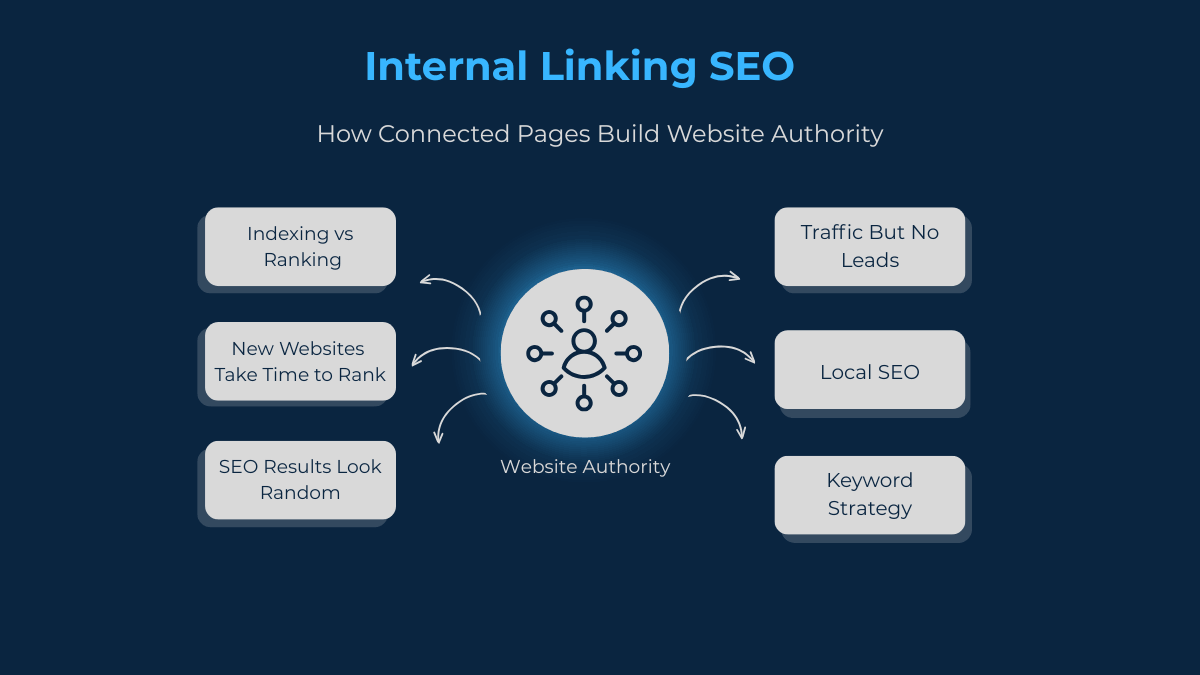
What It Actually Does Beyond Basic Navigation
Most people understand internal links as navigation tools. You click a link, you go to another page on the same website. That is true but it is the smallest part of what internal linking actually does.
From an SEO perspective, internal links are communication signals to Google. Every time you link from one page to another on your website, you are telling Google three specific things simultaneously.
First, you are telling Google that these two pages are related. The relationship between them matters and the reader who is on page A would benefit from page B.
Second, you are distributing what SEO professionals call link equity or page authority. Pages that receive more internal links from other strong pages on the site accumulate more authority over time. This is the same principle that makes external backlinks valuable, except internal links are entirely within your control and cost nothing.
How Internal Links Distribute Authority Across Your Website
Third, you are giving Google a clear map of your website’s structure. A website where all pages link to each other contextually is far easier for Google to understand than a website where pages exist in isolation. And a website Google understands clearly is a website Google ranks more confidently.
On Juyal Digital, I have deliberately connected blogs that cover the progression of how SEO actually works for a new website. For example:
- What Happens After You Publish a Blog
- Why Your Page Is Indexed but Not Ranking
- Why Your Website Is Getting Traffic But No Leads
Each of these blogs explains one concept. But together, they create a connected learning journey that signals topical depth to Google and guides readers through a logical progression rather than leaving them at a dead end.
According to Ahrefs research on internal linking, pages with strong internal link profiles consistently rank better than comparable pages with few internal links pointing to them, even when external backlink profiles are similar. Internal linking is one of the few ranking factors entirely within your control from day one.
Why Most Websites Get This Wrong
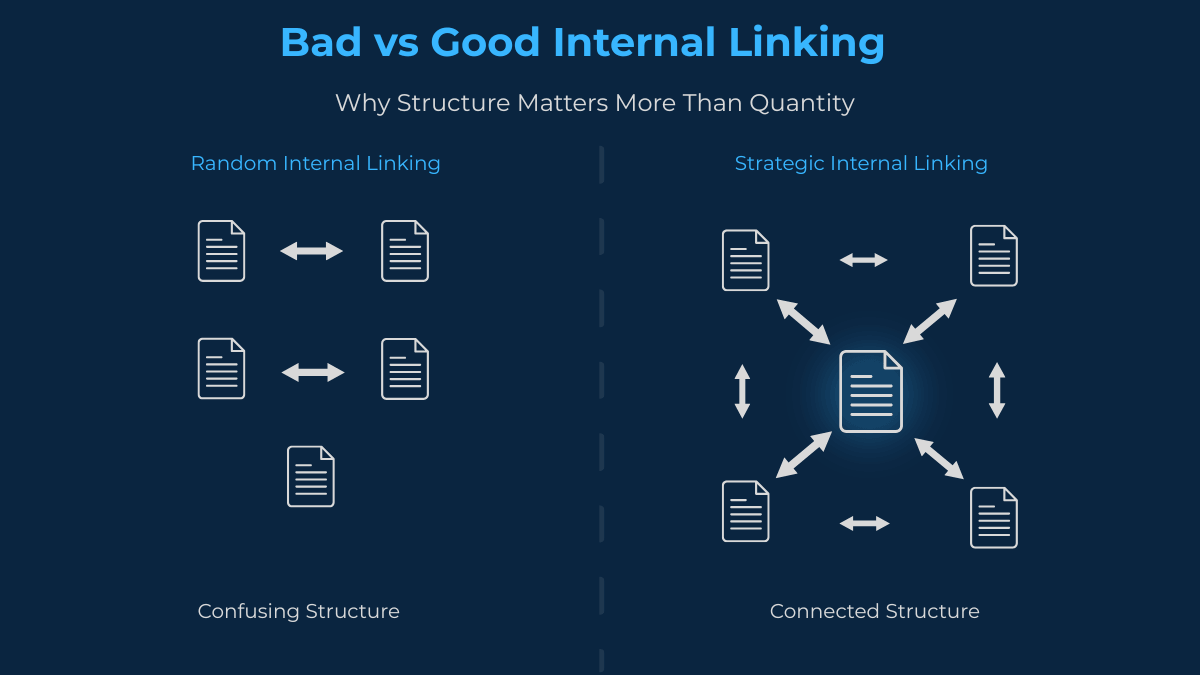
The most common mistake I see is treating internal linking as a mechanical SEO task rather than a structural decision. Pages get a few links added randomly after publishing, the anchor text is generic, the connections are forced, and the result does not actually help Google understand anything more clearly.
Here are the specific patterns that create weak internal linking structures:
- Generic anchor text: Linking with phrases like “click here” or “read more” gives Google no signal about what the linked page is about. Descriptive anchor text like “why new websites take time to rank” is far more useful.
- Forced links inside unrelated paragraphs: If the connection between two pages is not natural and logical, the internal link creates confusion rather than clarity, both for Google and for the reader.
- Too many links competing on one page: When every sentence contains a link, the authority signal gets diluted. Internal links are most powerful when they are selective and contextually justified.
- Orphan pages with no internal references: A page with no internal links pointing to it from elsewhere on the site is essentially invisible to Google’s natural crawl patterns. It can still be indexed through the sitemap, but it accumulates authority much more slowly.
- Blogs completely disconnected from service pages: This is one of the most costly mistakes for service businesses. Educational blogs build trust and attract traffic, but if they never guide the reader toward the relevant service page, that trust never converts into enquiries.
The principle that separates good internal linking from mechanical internal linking is logical continuity. The connection between two pages should make sense to a reader, not just exist for SEO purposes. When the relationship is genuine, it helps both the reader and Google simultaneously.
How It Helps Google Discover and Index Content Faster
One of the most underappreciated benefits of internal linking is its direct impact on how quickly Google discovers and evaluates new pages.
Google discovers content primarily through links. When Googlebot crawls your website, it follows the links it finds on each page. If a newly published page has strong contextual internal links pointing to it from already-indexed, well-established pages on the same site, Googlebot is likely to find it much faster than if it relies solely on the sitemap.
This matters enormously for new websites. In the early phase, you have limited domain authority and Googlebot may only visit your site every few days. Every page that sits without internal links pointing to it is a page that waits longer to be discovered, evaluated, and indexed.
What I Observed Personally While Building Juyal Digital
I experienced this directly while building Juyal Digital. When I published new blogs and immediately went back to add contextual internal links from two or three already-indexed pages, those new blogs consistently got discovered and indexed faster than pages I published without that internal link support.
This is also one of the practical actions I recommend in my blog about what happens after you publish a blog, where I cover the full process of what Google does between publishing and ranking, and how internal linking fits into that process.
In simple terms, internal links act as a road network inside your website. More roads connecting to a page means Googlebot finds it faster, visits it more often, and builds a clearer understanding of its relationship to the rest of your content.
Internal Linking and Topical Authority: Why Connected Content Ranks Better Than Isolated Content
Topical authority is one of the most important concepts in modern SEO, and internal linking is the primary tool for building it on a new or growing website.
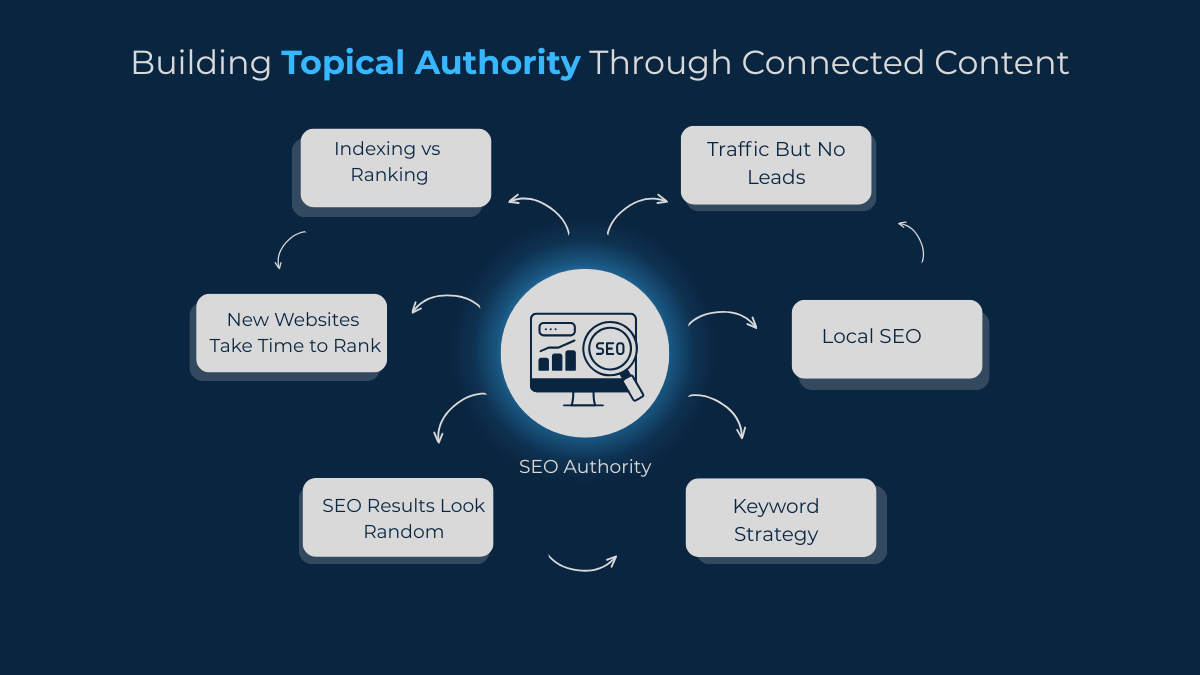
Here is what topical authority actually means in practice. When a website consistently covers multiple aspects of one subject area, with pages that reference and support each other, Google begins to evaluate that website as a reliable, in-depth resource on that subject. This depth of coverage, demonstrated through connected content, is what allows even newer websites to compete against more established ones for specific topic areas.
A single blog about SEO indexing tells Google one thing. But a website that has blogs about indexing, ranking, publishing processes, keyword strategy, traffic analysis, and local SEO, all connected through contextual internal links, tells Google that this website understands SEO at multiple levels and from multiple angles.
That thematic depth is topical authority. And internal linking is the system that communicates it.
How I Built Topical Authority on Juyal Digital Through Internal Linking
On Juyal Digital, I have built this deliberately. Blogs about why SEO results look random, why new websites take time to rank, and the difference between indexing and ranking all support each other and point toward the same topical ecosystem. Each one makes the others more valuable in Google’s eyes because together they demonstrate consistent depth.
This is also why content clusters consistently outperform isolated blog strategies in SEO. It is not just about the volume of content. It is about how that content is organised and connected.
How Internal Linking Guides Users and Improves Behaviour Signals
Internal linking is not only for search engines. It directly shapes how users experience and move through your website, and that behaviour feeds back into how Google evaluates your pages.
When a visitor lands on one of your blogs and finds a relevant, clearly framed internal link to another page that extends their understanding, they are likely to follow it. That continues their session on your website. It increases time on site, deepens their engagement with your content, and most importantly for service businesses, it builds the familiarity and trust that eventually leads to contact.
Google observes these behaviour patterns. A website where visitors consistently explore multiple pages during a single session sends a strong quality signal. It tells Google that the content ecosystem is genuinely useful, not just individually relevant pages.
How This User Journey Works for a Local Business in Haridwar
For a local business trying to attract clients in Haridwar, this journey matters enormously. A potential client might first land on a blog explaining why Haridwar businesses are not getting customers online. From there, a well-placed internal link can guide them to understand whether SEO is worth it for their specific business. And from there, a contextual link to my SEO services in Haridwar page turns an informed reader into a potential client.
That entire conversion journey is built through internal links. Without them, each of those pages is a dead end.
Why Some Pages Suddenly Start Ranking After Internal Linking Improvements
This is something I have observed on Juyal Digital and it is one of the most satisfying validations of what internal linking can do.
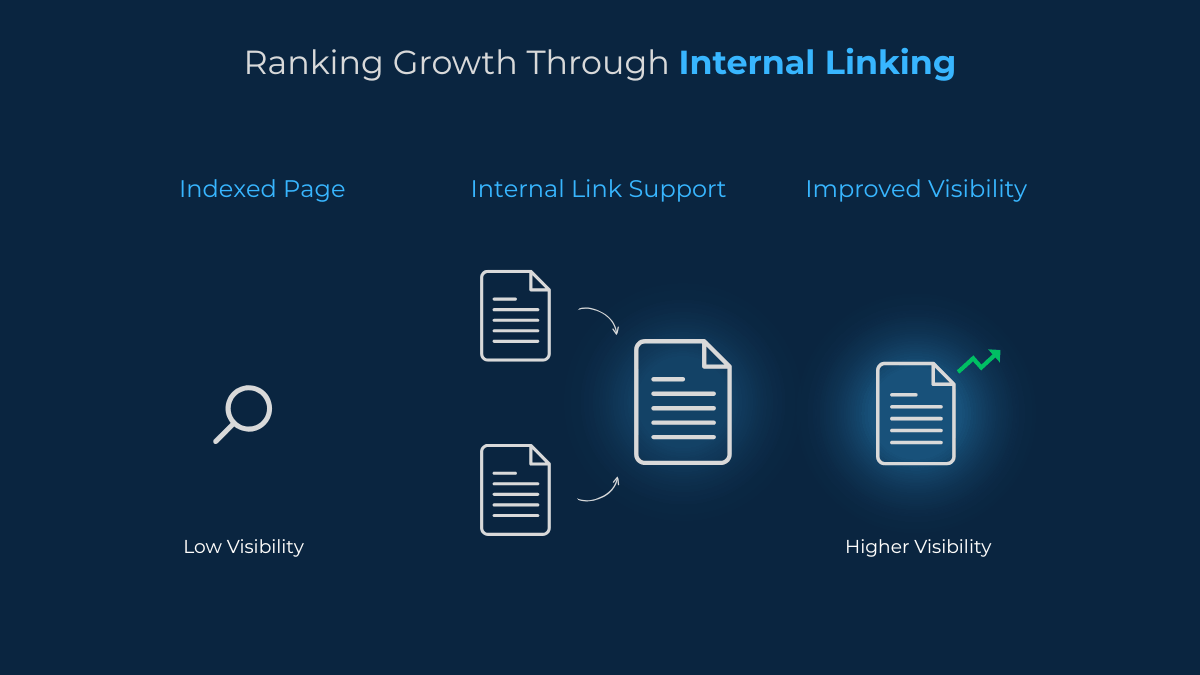
A page can sit indexed for weeks with minimal impressions. Then, after adding two or three strong contextual internal links from already-performing pages, that page starts appearing in Search Console for queries it was not showing before.
The reason this happens is not mysterious. When a page receives internal links from already-trusted pages on the same site, Google re-evaluates it in a new context. The page is no longer isolated. It now has a clear relationship to content Google already understands and trusts. That context helps Google make a more confident assessment of what the page is about and where it fits in search results.
This does not happen instantly and it does not guarantee rankings. But it consistently accelerates the process. The pages I have supported with the strongest internal link ecosystems on Juyal Digital have shown the clearest and fastest visibility progression in Google Search Console.
This is also connected to why some websites rank faster than others, which I covered in detail in why some websites rank faster than others in SEO. Internal link structure is one of the foundational differences between a website that gains traction quickly and one that publishes content without ever seeing meaningful results.
How I Approach This Strategically on Juyal Digital
My approach to internal linking is not about inserting the maximum number of links possible. It is about building a structure where every link earns its place.
Here is the specific process I follow:
I start with the destination, not the source. Before thinking about which pages to link from, I identify which pages on the site are most important to strengthen. These are usually the service pages and the cornerstone content. Then I look for every blog that logically connects to those pages and add contextual links from those blogs toward the priority destination.
I use descriptive anchor text that reflects the content of the destination page. Instead of “click here” or “read this blog”, I use anchor text like “why indexed pages stay stuck after publishing” or “how Google evaluates new websites in the early phase”. This gives Google a clear signal about the relationship between the two pages.
I link new pages immediately after publishing. The first thing I do after publishing a new blog is go back to two or three existing indexed pages and add a contextual internal link to the new one. This ensures the new page gets discovered quickly and enters Google’s evaluation cycle with existing support rather than sitting in isolation.
I make sure links flow in both directions where logical. If blog A links to blog B because they cover related concepts, I check whether blog B should also link back to blog A at the right contextual moment. Two-way linking between genuinely related pages strengthens the relationship signal for both.
Connecting Educational Content to Service Pages the Right Way
I connect educational content to service pages only where the transition feels natural. Forcing a link from a technical SEO blog to a service page mid-explanation feels jarring and damages trust. But at the end of a blog, or in a section discussing practical applications, linking to a relevant service page feels like a natural next step for a reader who wants help applying what they just learned.
This is the approach I apply when linking from educational SEO blogs to my SEO services in Dehradun page. The content around that link always sets up why a business in Dehradun would benefit from this specific approach, so the link feels like a helpful next step rather than a sales interruption.
The Difference Between Internal Linking That Builds Authority and Internal Linking That Does Not
Not all internal links carry equal weight. Understanding the difference between a strong internal link and a weak one helps you be more deliberate about where you invest the effort.
A strong internal link comes from a page that is already indexed, already receiving impressions or traffic, and is topically related to the destination page. It uses descriptive anchor text, sits within a paragraph that provides natural context for why the reader would benefit from clicking, and points to a page that genuinely expands on what was just discussed.
A weak internal link comes from a page that has no authority of its own, uses generic anchor text, appears in an unrelated section of the content, or points to a page that does not naturally follow from the current topic. This kind of link exists on paper but does not meaningfully move either page forward.
Why Your Strongest Pages Are Your Most Valuable Linking Assets
The practical implication of this is that you should prioritise building internal links from your strongest pages to your most important pages. If you have a blog that is already getting consistent impressions in Google Search Console, that blog is valuable real estate. A contextual internal link from that blog to a newer, less established page passes credibility in a way that a link from an obscure, unvisited page simply cannot replicate.
This is why, as your website grows, it pays to periodically audit your internal linking structure. Look at which pages are performing well in GSC and check whether they are pointing toward your most important destination pages. If not, that is a straightforward improvement that can meaningfully impact how Google distributes attention across your website.
Final Thoughts
Internal linking SEO is not a small technical task. It is one of the core systems that determines how both Google and users understand your website as a whole.
A strong internal linking structure improves topical authority, accelerates indexing, distributes page authority intelligently, guides users toward the next logical step, and sends Google the clearest possible picture of what your website is about and which pages matter most.
Many websites underestimate how much growth potential already exists inside their own content ecosystem. The problem is often not a lack of content. It is that the content is not connected in a way that allows Google to see its full value.
In modern SEO, structure compounds just like content does. Build both deliberately, and the results will reflect that.
If you want to see how this approach works in practice on a real website, you can follow the full progression in my SEO case study, where I document how strategic internal linking contributed to early visibility on a brand new domain with zero starting authority.