
How Long Does SEO Take for a New Website? Why Results Feel Slow at First and Compound Over Time
How long does SEO take is one of the first questions almost every new website owner asks. It is a completely fair question. SEO requires real time, consistent effort, and patience, so wanting clarity on when results will start showing is entirely reasonable.
The honest answer is that SEO does work, but it rarely works instantly, and for new websites specifically, the early phase often feels like nothing is happening even when everything is building correctly underneath. Understanding why this happens, and what the realistic progression looks like, changes how you approach the entire process.
In this blog I will explain why SEO feels slow at first, what the realistic timeline looks like for a new website, how results compound over time, and what you can focus on instead of checking rankings every day.
Why SEO Always Feels Slow at the Beginning for New Websites
When a website is new, Google has no history to rely on. It has not seen how the site behaves over time, whether the content is consistent, whether users find it useful, or whether the business behind it is genuine. Because of this uncertainty, Google approaches new websites cautiously. It evaluates before it rewards.
What Google Is Actually Doing in the Early Weeks
In the first few weeks after a website launches, Google focuses on discovering pages, crawling content, and building an initial understanding of the website’s structure and purpose. At this stage there are no rankings and almost no traffic. But that does not mean nothing is happening. It means Google is doing the groundwork that everything else depends on.
This early evaluation phase is the reason why new websites almost always take longer to see results than established ones. Google is not punishing new websites. It is simply being careful about what it shows to users before it has gathered enough data to be confident.
I have explained the mechanics of this evaluation period in detail in my blog on why new websites take time to rank on Google, which covers exactly what Google is looking for and why the trust-building process takes the time it does.
In simple terms, Google first tries to understand who you are before deciding where to place you. And that understanding does not happen overnight.
If you prefer a quick visual explanation, I have covered how SEO timelines work for new websites in the video below.
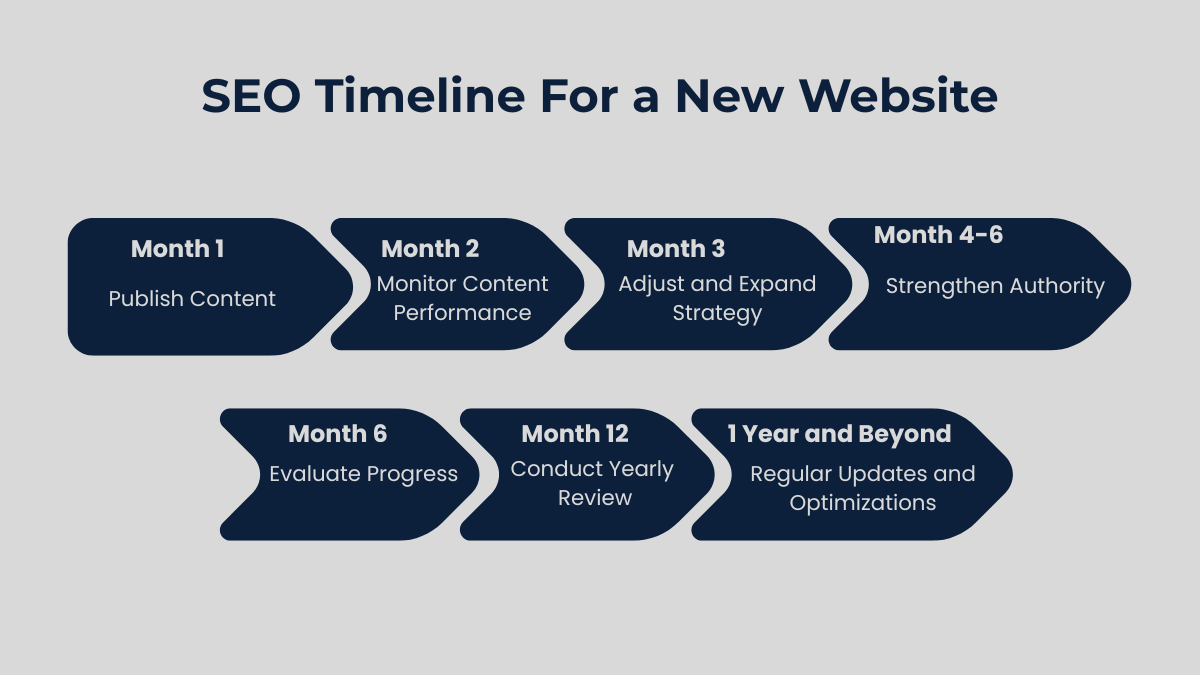
The Realistic SEO Timeline for a New Website
How long SEO takes varies depending on several factors including domain age, content quality, internal linking structure, the competitiveness of the keywords being targeted, and the consistency of publishing. But there is a general pattern that most well-built websites experience when SEO is approached correctly.
The First Few Weeks: Discovery and Crawling
During the first few weeks, Google focuses on discovering pages, crawling content, and understanding how the website is structured. This stage is largely invisible from the outside. You may not see any traffic, any rankings, or any meaningful data in Google Search Console.
The most useful action during this phase is submitting your XML sitemap to Google Search Console, requesting indexing for your most important pages, and ensuring your internal linking is clear enough for Googlebot to move through the site efficiently. These actions do not produce immediate visible results but they set the foundation for everything that follows.
The First Two to Three Months: Early Impressions
After the first month or so, most well-structured new websites begin seeing their first impressions in Google Search Console. This means pages are starting to appear in search results, even if clicks are still minimal. Positions may be high numbers like 40 or 60, which feel discouraging, but they are meaningful signals that Google is beginning to test your content against real queries.
During this phase, Google is essentially running quiet experiments. It shows your pages to small audiences for specific queries and observes what happens. Do users click? Do they stay? Or do they return to the search results immediately? This behaviour data is what Google uses to decide whether your content genuinely satisfies the queries it is being shown for.
I covered this testing process in detail in my blog on why SEO results look random at first, which explains why early visibility feels inconsistent and what Google is actually doing during this evaluation period.
Three to Six Months: Rankings Begin to Stabilise
Once Google has observed consistent content quality, stable internal linking, and positive user engagement patterns, rankings begin to stabilise more meaningfully. Pages start settling into more predictable positions. The impression count in Search Console grows more steadily. Click-through rates begin to improve as positions move higher.
This is the phase where SEO starts feeling real. Growth is still gradual but it is now visible and measurable. The keywords that were showing at position 40 start appearing at position 20 or 15. Pages that had zero clicks begin generating consistent visits.
Beyond Six Months: Compounding Growth
For websites that maintain consistency beyond the six-month mark, SEO growth begins to compound in a way that feels qualitatively different from the earlier phases. New pages benefit from the domain authority built by earlier pages. Internal links between established content strengthen the entire website’s topical relevance. Google’s crawl frequency increases, meaning new content gets discovered and evaluated faster.
This compounding phase is where the patience of the early months begins to pay off in ways that become increasingly difficult for newer websites to close the gap on.
Why SEO Results Compound Over Time
SEO does not grow in straight lines. It builds on itself in ways that accelerate over time, which is why the first few months feel so slow compared to later stages.
How the Compounding Effect Actually Works
Each piece of helpful content improves Google’s understanding of what your website is about. Each internal link strengthens the relationship between pages and distributes authority across the site. Each new page that ranks adds another entry point through which visitors can discover the website. And each positive user interaction builds the behavioural trust signals that Google uses to evaluate whether your site deserves higher positions.
None of these effects are instant. But they are cumulative. A website that has been publishing consistently for twelve months does not just have more content than a website that started six months ago. It has a more complex, more interconnected, more trusted ecosystem of pages that collectively generates far more visibility than the sum of each page individually.
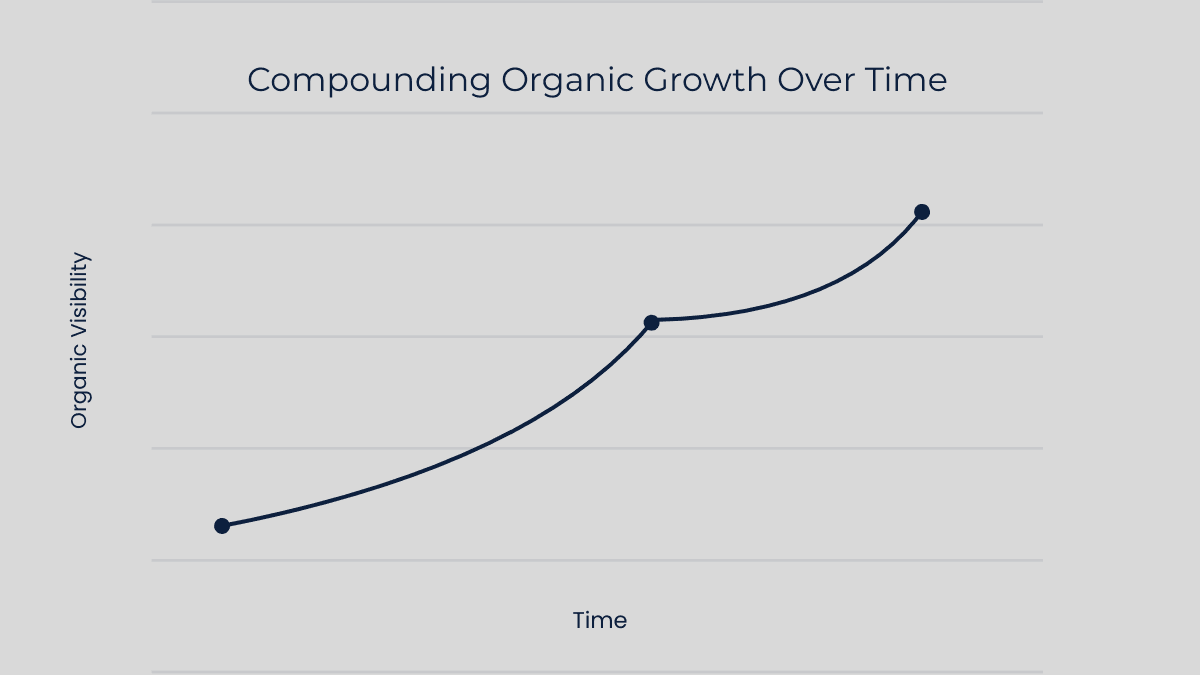
In simple terms, SEO grows like compounding interest. The early months feel slow because the base is small. But as the base grows, each new addition produces larger returns than the same addition would have produced earlier. This is why websites that stay consistent through the difficult early phase eventually see growth that feels disproportionate to the effort being invested.
According to Ahrefs research on how long SEO takes, most pages that rank in the top 10 on Google are over two years old, and only a small percentage of newly published pages reach the first page within a year. This is not discouraging. It is simply evidence of how the compounding model works, and why starting earlier and staying consistent is the most reliable path to meaningful organic visibility.
What SEO Progress Looks Like Before Rankings Improve
One of the biggest sources of frustration for new website owners is the assumption that progress only means visible rankings and traffic. In reality, SEO progress shows itself in quieter, earlier ways that most people do not know how to read.
The Early Signals That Show SEO Is Working
Search impressions in Google Search Console begin increasing before clicks do. This means your pages are appearing in search results and being seen by users, even if they are not yet clicking. More pages appear in the coverage report as indexed. New search queries start showing up in the queries report, often for terms you did not specifically target, which signals that Google is beginning to understand the broader topical relevance of your content.
Crawl frequency increases as Google returns to the site more regularly. Average position numbers begin declining gradually as rankings improve. These are all positive signals that SEO is working, even when traffic numbers have not yet moved significantly.
I have covered how to read these early signals specifically in my blog on how to know if your SEO is working before rankings improve, which walks through exactly which indicators in Search Console show genuine progress during the months before rankings become clearly visible.
In simple terms, SEO shows signals before it shows results. Learning to read those signals makes the early phase far less frustrating.
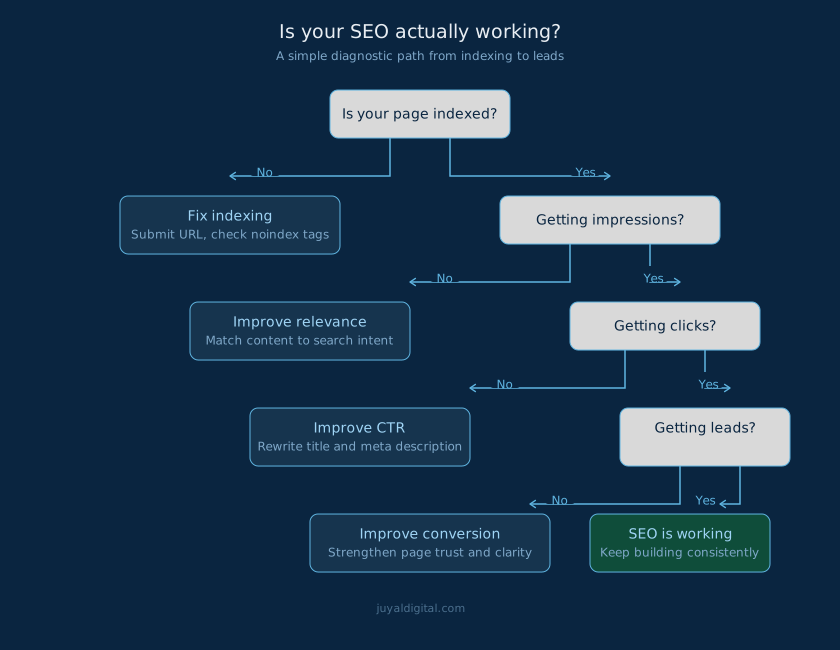
If you are unsure where your website currently stands, use the framework below to identify the stage of your SEO journey before making changes. It can help you determine whether your focus should be on indexing, visibility, clicks, or improving conversions.
What Slows SEO Down for Most New Websites
In many cases, SEO slows down not because the approach is wrong, but because it gets interrupted. Understanding the most common interruptions helps you avoid them.
The Mistakes That Reset SEO Progress
Making frequent significant changes to pages that Google is already evaluating is one of the most common causes of slow SEO progress. Every major rewrite or structural change to an already-indexed page effectively asks Google to start its evaluation of that page over again. The data it had collected about how users interacted with the original version becomes less relevant.
Expecting immediate results and changing strategy too quickly is the second major interruption. Many website owners try SEO for two or three months, see limited visible results, and conclude it is not working. This almost always happens exactly when the foundational phase is ending and the early compounding phase is about to begin. Abandoning the strategy at this point means starting over from zero rather than benefiting from the signals already accumulated.
Over-optimising pages in the early phase is another common problem. Keyword stuffing, forced internal links, and unnatural content structures confuse Google rather than helping it. Clean, natural content that genuinely serves the reader produces better signals than content built around SEO mechanics alone.
I have covered this specific set of mistakes in more detail in my blog on why doing more SEO too early can slow down your rankings, which explains why reactive over-intervention in the early phase consistently produces worse outcomes than patient, consistent building.
What You Should Focus on Instead of Checking Rankings Daily
For new websites, long-term progress comes from consistency and clarity, not from monitoring rankings obsessively. Daily ranking checks during the early phase provide very little useful information and create anxiety that often leads to the reactive decisions that slow everything down.
The Right Actions at Each Stage of SEO Growth
In the first three months, focus on publishing consistently around a focused topic area, building clean internal links between every new page and existing related pages, submitting URLs to Search Console after publishing, and ensuring your website’s technical foundations are clean. These actions create the conditions Google needs to evaluate your site accurately.
From months three to six, focus on deepening the topical coverage of your content ecosystem. Every new blog should connect to existing content and strengthen the internal linking structure. Monitor Search Console for emerging query patterns and create content that addresses the related questions your existing pages are beginning to rank for.
Beyond six months, focus on building the external signals that reinforce the internal foundation already built. Local citations, Google Business Profile optimisation, and earning genuine backlinks from relevant sources all become more impactful once the website already has the internal structure to benefit from them.
This is the approach I follow at Juyal Digital, both on this site and with local businesses I work with. If you want to understand what this looks like in practice as a structured process, you can explore my SEO consulting services page or read my SEO case study documenting how this progression played out on a real new website from launch.
For businesses in Haridwar specifically, this same timeline and approach applies. The foundational SEO work for a local business follows the same compounding pattern, which is why I explain the full local context in my SEO services in Haridwar page for businesses ready to start building their search visibility properly.
How This SEO Approach Supports Long-Term Visibility
The connection between informational content and commercial page visibility is one of the most underappreciated aspects of how SEO actually works for service businesses and local businesses alike.
Why Blogs Make Service Pages Easier to Rank
When a website demonstrates genuine topical expertise through its educational content, Google becomes significantly more confident about ranking that website’s service and location pages for commercial queries. A blog ecosystem that clearly establishes a website as a knowledgeable resource in its field makes the service pages feel like a natural extension of that expertise rather than an isolated commercial pitch.
On Juyal Digital, the informational blogs covering SEO fundamentals, indexing, ranking behaviour, and local SEO strategy collectively build the topical authority that makes the service pages more credible to Google. Each educational page supports the commercial pages it connects to through internal links.
This is also why I connect related topics across the blog using internal linking. Blogs like what happens after you publish a blog, why your page is indexed but not ranking, and why some websites rank faster than others all reinforce each other and the service pages they connect to.
In simple terms, strong blogs make important service pages easier for Google to rank. The educational foundation supports the commercial structure built on top of it.
Final Thoughts
How long SEO takes depends on consistency, patience, and the quality of the foundation being built. It is not instant, but it is predictable when done correctly.
Results feel slow at first because evaluation comes before visibility. Growth compounds because trust and topical authority build on themselves over time. Websites that stay consistent through the difficult early phase almost always see meaningful progress. Websites that rush, react, or abandon the process early miss the compounding phase entirely.
SEO rewards steady effort, not urgency. The websites that understand this and commit accordingly are the ones that build something genuinely valuable rather than chasing shortcuts that produce nothing lasting.
If you are at the stage where your website is new and results feel slow or inconsistent, my blog on what to do when your new website is not ranking yet covers the specific actions that move things forward during this phase without disrupting the signals already being built.