
Why SEO Results Look Random at First, and How Google Actually Tests New Pages
If you have ever wondered why SEO results look random in the beginning, you are not imagining things. One day a page shows impressions. The next day it disappears. Rankings shift without any obvious reason. Nothing feels predictable, and the natural conclusion is that SEO does not work or that something is broken.
In reality, what looks random is almost always part of a deliberate process. Google does not rank pages instantly or permanently. It tests them first, evaluates them over time, and adjusts its confidence gradually before committing to stable positions.
Understanding why this happens changes how you respond to early SEO behaviour. Instead of reacting to every fluctuation, you start recognising the patterns underneath them.
Prefer a quick explanation? I have explained why SEO results look random at first and how Google tests new pages in the short video below.
Why SEO Feels Confusing and Random in the Beginning
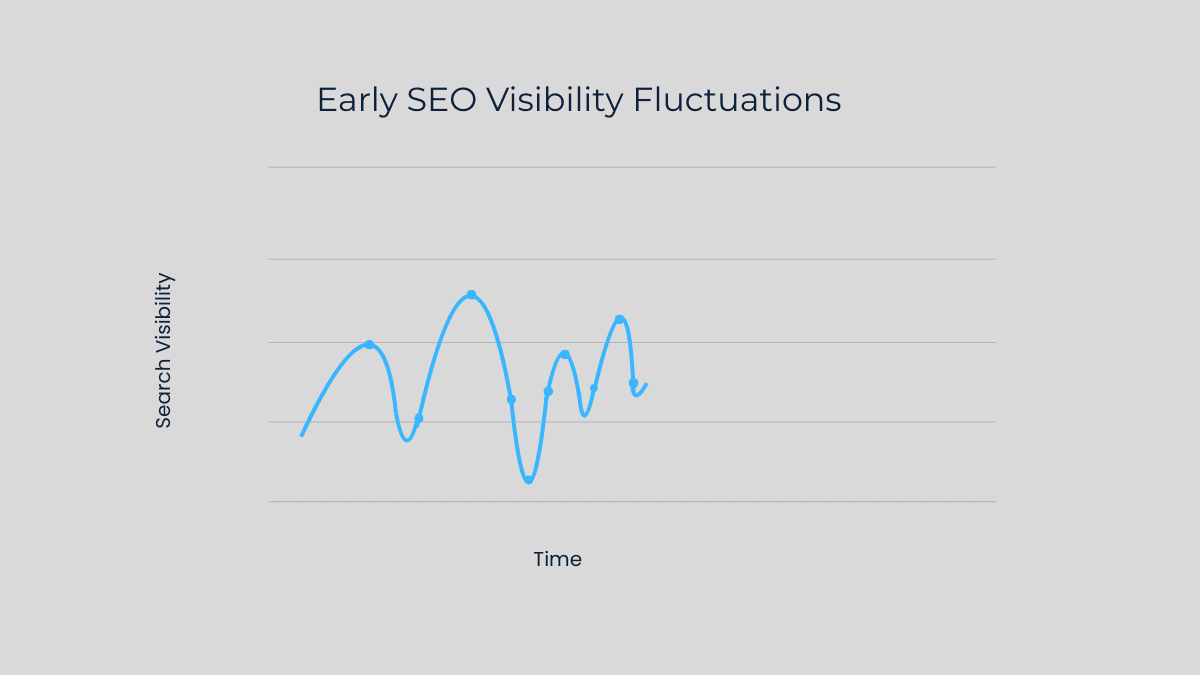
In the early stages, SEO rarely follows a straight line. New pages may appear briefly in search results, receive a few impressions, and then fade away entirely. A page that showed up at position 18 on Monday might not appear at all by Friday.
This behaviour is normal. It does not mean something is broken, and it does not mean your content failed. It means Google is in the middle of a process most website owners never see.
In simple terms, SEO results look random in the beginning because Google is still learning how your page fits into the search ecosystem. It has indexed your page but it has not yet committed to a position for it. That commitment comes through testing, and testing takes time.
This confusion is also closely connected to what I have observed while building Juyal Digital. In the first few months, pages would appear for queries I had not specifically targeted, disappear for queries I had optimised for, and occasionally show up at wildly different positions on consecutive days. Once I understood this was evaluation behaviour rather than failure, the whole process became much easier to navigate with patience rather than reaction.
Why Early SEO Visibility Looks Inconsistent
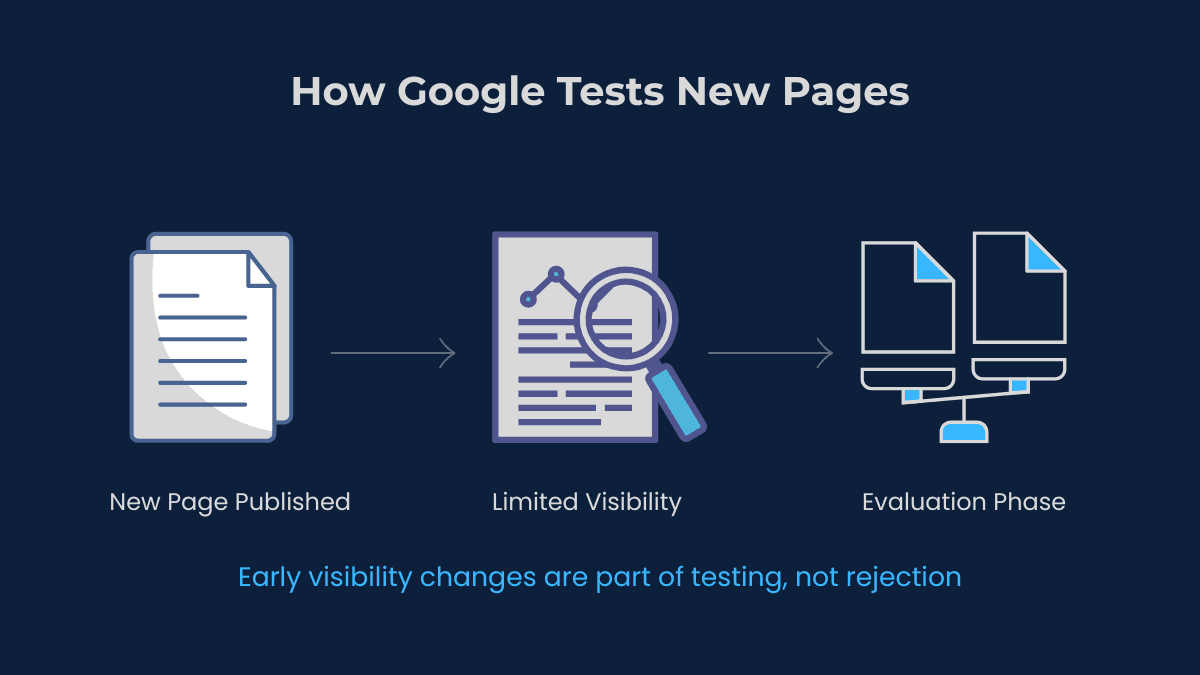
When a page is new, Google does not immediately know how users will respond to it. Instead of showing it widely and risking a poor user experience, Google tests it in limited, controlled situations first.
This can result in short bursts of visibility followed by periods of silence. A page might appear in Search Console with 12 impressions one week and then drop to 2 the next. This is not regression. It is Google gathering data from small sample audiences before deciding how broadly to show the page.
The inconsistency also happens because Google is comparing your page against multiple competitors simultaneously. Your position on any given day reflects how your page performed relative to alternatives during that testing window, not a final assessment of its quality.
In simple language, Google is experimenting quietly before making bigger decisions. The early volatility is the experiment in progress.
How Google Actually Tests New Pages
Google tests new pages by showing them to small audiences for specific queries and observing how those users interact with the results. During this phase, Google compares your page against other indexed pages targeting similar queries and watches which pages users prefer.
The testing is not random in its design. Google selects specific queries to test your page against based on what it understood from crawling your content. It then monitors whether users click your result, how long they stay on your page, whether they return to search results immediately, and whether they visit other pages on your site.
Each of these interactions tells Google something about how well your page satisfies the query. A page that users click, stay on, and do not immediately abandon sends positive signals. A page that users skip or leave immediately sends a different signal. Over multiple testing cycles, Google builds a confident picture of where your page belongs.
In simple terms, Google watches first and decides later. The decision only comes after enough data has been collected.
What Google Is Evaluating During This Testing Phase
During early testing, Google is looking at a combination of content signals and user behaviour signals simultaneously. Neither alone is enough to determine ranking. It is the combination of both that builds Google’s confidence.
The content signals include how well the page matches the search query, whether the content provides clear and genuinely useful information, how the page is structured, and how it connects to other pages on the website through internal links.
The user behaviour signals include how often users click the result when it appears, how long they spend on the page, whether they explore other pages on the same website, and whether they return to the search results immediately after landing, which signals the page did not satisfy the query.
What makes this phase particularly important to understand is that both sets of signals need time to accumulate. Google does not make ranking decisions from a single data point. It needs to observe patterns across multiple testing cycles before it feels confident enough to assign a stable position.
None of these signals work instantly. They require time and repeated observation to build into a clear picture.
Why Results Can Appear and Disappear Temporarily
As Google gathers data, it may pull a page back from results temporarily to compare it against newer or recently updated competing pages. This can make your rankings appear and disappear seemingly without reason.
This is not a penalty. It is comparison behaviour. Google is essentially asking: is this page still the best available answer for this query, or has something better appeared since we last checked?
For new websites this comparison happens more frequently because Google has less historical confidence to rely on. An established website with years of positive signals gets the benefit of the doubt during these comparisons. A new website gets tested more rigorously because Google is still building its confidence in the domain.
This is also one of the reasons why some websites rank faster than others, which I have explained in detail in my blog on why some websites rank faster than others in SEO. The speed of moving through the testing phase is directly related to the trust signals already accumulated on the domain.
In simple terms, temporary visibility changes are signs of active testing, not rejection.
How This Testing Phase Relates to Indexing and Ranking
Indexing makes a page eligible to appear in search results. Ranking decides where it belongs and how consistently it appears. The testing phase sits between these two steps and is the part most people do not realise exists.
Most website owners check Google Search Console, see their page indexed, and expect rankings to follow quickly. When they do not, the assumption is that something is wrong. But the reality is that the page is simply in the testing and evaluation phase, which is a normal and necessary part of the process.
I have explained the full distinction between these two stages in my guide on indexing vs ranking, and the complete picture of what Google does between publishing and ranking in my blog on what happens after you publish a blog.
Understanding these three stages, indexing, testing, and ranking, as separate processes rather than one automatic event changes how you read the data in Google Search Console entirely.
Why SEO Results Look Random Longer on New Websites Than Established Ones
This is the part most SEO content skips over, but it is one of the most practically important things to understand if you are working on a new website.
The length of the testing phase is not fixed. It varies significantly based on the trust signals already present on the domain. An established website with years of crawl data, strong user behaviour patterns, and consistent content quality gets tested much faster. Google already knows what to expect from that domain. A single new page can move from indexing to stable ranking in days.
A new domain has none of that history. Google approaches every page on a new domain with caution because it has no track record to rely on. The testing cycles are longer, the comparison windows are wider, and the bar for confidence is higher before stable rankings are assigned.
How This Starting Condition Improves Over Time
This is not a permanent disadvantage. It is a starting condition that improves with every month of consistent, quality publishing. The longer a domain demonstrates reliable content and positive user signals, the shorter and faster the testing phase becomes for new pages.
I have covered this progression in detail in my blog on why new websites take time to rank on Google, where I explain the full timeline of what to expect and why patience in the early phase is not just advice but a structural requirement of how Google works.
For local businesses in areas like Haridwar, this matters especially because many business owners expect immediate results after launching a website. Understanding that the testing phase is a normal part of the process, not a failure, is what keeps the strategy on track rather than leading to reactive decisions that slow things down further. You can read more about how this applies specifically to local businesses in my SEO services in Haridwar page.
Why Patience and Consistency Matter More Than Intervention During Testing
Frequent changes during the testing phase can slow down evaluation significantly. When content changes too often, Google cannot collect stable comparative data about your page. Each change essentially resets the data Google has gathered and asks it to start the evaluation cycle again.
This is one of the most common and costly mistakes in early SEO. A page that has been tested for six weeks and is showing early positive signals gets rewritten out of impatience, and the entire testing cycle starts over from zero.
Consistency during this phase does not mean doing nothing. It means continuing to publish related supporting content, strengthening internal links, and allowing the page to gather stable behaviour data without disrupting it.
According to Google’s own guidance on creating helpful content, the focus should always be on producing content that genuinely serves the user rather than reacting to short-term ranking fluctuations. This principle applies directly to the testing phase: the best thing you can do is ensure the page is as clear and useful as possible, then allow Google the time it needs to evaluate it properly.
I have explained this timing and progression more clearly in my article on how long SEO takes for a new website, where I cover realistic expectations for each phase of the process.
Common Mistakes People Make When SEO Results Look Random
Many people react too quickly when they see unstable results because the instinct is to fix something. But the testing phase rarely needs fixing. It needs time.
The most common mistakes I see at this stage are rewriting content repeatedly, adding or removing keywords based on daily ranking checks, changing the page title or meta description every few weeks, and making structural changes to the site while Google is still evaluating its existing pages.
Each of these actions interrupts the data collection process. Instead of building toward a stable assessment, the page keeps resetting to an earlier evaluation stage.
The harder but more effective approach is to publish supporting content around the topic, add internal links from already-indexed pages to the page being tested, and then wait. The data accumulates faster when the surrounding content ecosystem is growing than when the page itself is being changed repeatedly.
This is also closely connected to what I explained in my blog on why doing more SEO too early can slow your rankings. Over-intervention in the early phase is one of the most consistent patterns I have observed in websites that struggle to gain traction despite publishing good content.
What Happens When the Testing Phase Ends
As Google collects enough consistent data, the testing phase gradually transitions into more stable ranking behaviour. The fluctuations become smaller. Impressions start growing more steadily. Position averages begin to settle into a recognisable range.
This does not mean rankings become permanent or that testing stops entirely. Google continues to evaluate pages throughout their lifetime, especially when competing pages are updated or when search behaviour around a query shifts. But the wild swings of the early phase give way to a much more predictable pattern.
On Juyal Digital, I started seeing this transition happen around the three to four month mark for the first blogs published. Impressions stopped appearing and disappearing randomly and started growing in a more consistent direction. That shift is one of the clearest signs that the testing phase is giving way to more stable evaluation.
If you are at the stage where your page is indexed but visibility still feels completely unstable, reading my blog on why your page is indexed but not ranking will give you a clearer picture of exactly what Google is doing during this period and what conditions tend to move a page forward.
When SEO Results Usually Start to Stabilize
Over time, Google collects enough data to make more confident decisions. Visibility becomes steadier and patterns begin to form. Position averages in Search Console stop fluctuating daily and settle into ranges that you can start making strategic decisions around.
The timeline varies. For competitive queries on new domains, three to six months of consistent publishing and stable content is often required before meaningful stabilisation. For lower-competition queries or long-tail topics, it can happen faster.
What looks random at first almost always becomes predictable later, once enough data has accumulated on both sides, yours and Google’s.
Final Thoughts
SEO results rarely behave randomly. They only appear that way before enough information is available for Google to make confident decisions.
Early fluctuations are a sign that Google is testing, learning, and comparing. The instability is the process working as designed, not failing.
What looks confusing in the beginning is usually Google doing its job carefully. Your job during that period is to give it clear, consistent signals rather than reacting to every shift in the data.
If you want to see how this testing and evaluation process played out in practice on a real website, I have documented the full progression in my SEO case study, including how impressions grew, where fluctuations appeared, and what eventually led to more stable visibility.